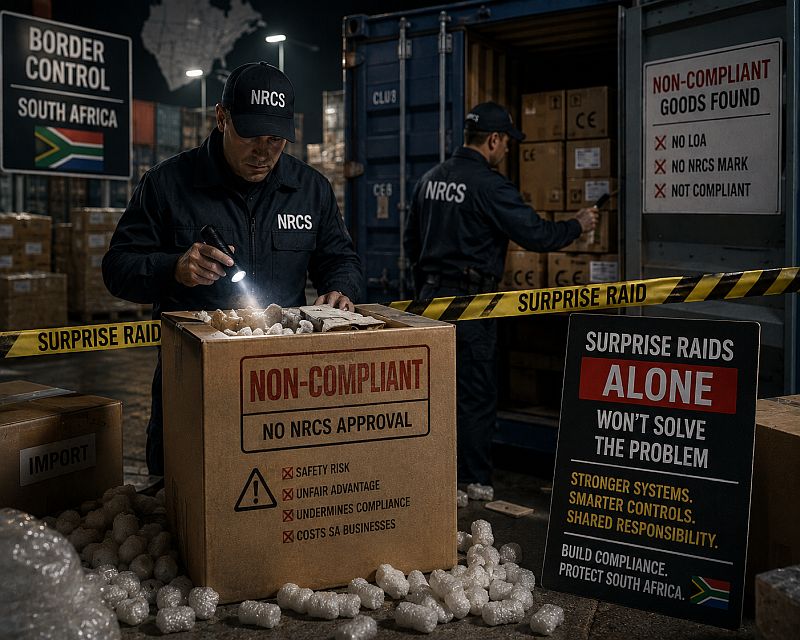
Last week, the National Regulator for Compulsory Specifications (NRCS), together with the South African Police Service and other agencies, carried out high-impact surprise raids in the Johannesburg CBD. Unsafe and non-compliant products were seized, and non-compliant traders were held accountable.
While these operations are necessary and welcome, they highlight a deeper problem: raids on their own are not enough to control the flow of illicit and non-compliant goods into the South African market.
Detection Is Not Prevention
NRCS Acting Chief Executive Duncan Mutengwe was frank about the limitations. He described the raids as “detection rather than prevention.”
“We are detecting what is already in the market as opposed to shutting them down right at the point of entry,” he said.
Porous borders and limited capacity at ports of entry mean that large volumes of unapproved products continue to enter the country. Once those goods are on the shelves, regulators are left chasing the symptoms instead of stopping the problem at source.
The Scale of the Problem
The NRCS estimates that non-compliant products across its regulated sectors are currently valued at approximately R3.8 billion. The regulator has set a target of removing R3.3 billion worth of these goods from the market in the current financial year through collaborative enforcement.
Yet even if that target is met, the underlying supply chains often remain intact. As Dr Lardo Stander of the Tshwane Economic Development Agency pointed out, a raid can remove stock worth millions, but if the importer, wholesaler, logistics network and ultimate beneficiaries are left untouched, the seized goods are simply replaced.
Why Compliant Businesses Lose Out
Legitimate importers and manufacturers carry significant costs that non-compliant operators avoid:
- Customs duties and VAT
- NRCS LOA and certification costs
- Proper testing and laboratory fees
- Labour and tax obligations
- Regulatory compliance expenses
When non-compliant goods are sold without these costs, they undercut compliant businesses on price. This distorts the market and penalises those who follow the rules.
What Needs to Change
Experts argue that lasting progress requires more than retail-level raids. Key areas that still need attention include:
- Stronger controls at ports of entry and land borders
- Better coordination between customs, the NRCS and other agencies at the point of importation
- Meaningful penalties that act as a real deterrent (the current maximum of three months’ imprisonment or a R1 000 fine is widely regarded as inadequate)
- Action against the full supply chain, not only the final retailer
Until these structural issues are addressed, high-profile seizures will continue to generate headlines while the overall volume of non-compliant goods remains high.
What This Means for Legitimate Importers
For companies that already invest in proper testing, LOAs and compliance, the continued presence of non-compliant products in the market is both a commercial and a regulatory risk. It creates unfair competition and increases the chance of broader market surveillance actions that can affect compliant traders as well.
The message is clear: obtaining and maintaining a valid LOA is not just a legal requirement — it is also a commercial defence in a market still flooded with unapproved goods.
At Advanced Technical Services we continue to help importers secure the correct test reports and LOAs so that their products can compete on a level playing field. If you are importing regulated goods and want to ensure your documentation is in order, we are available to assist.
Stay compliant. Avoid delays. Protect your business.