
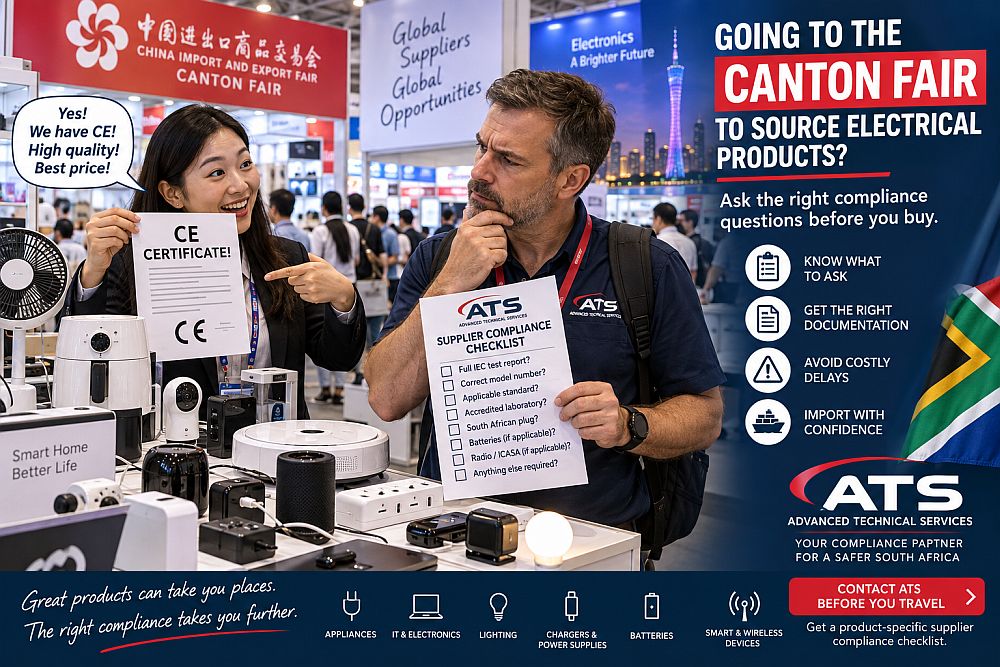
The Canton Fair can be an exciting place for South African importers.
Thousands of products. Hundreds of potential suppliers. New technology, attractive pricing and plenty of manufacturers eager to do business. But there is one question that should be asked before you place an order: Can this product actually be approved for legal sale in South Africa? For many electrical and electronic products, finding a good product at a good price is only the beginning. Depending on the product, South African regulatory requirements may include an NRCS Letter of Authority (LOA), and potentially other approvals. The best time to investigate those requirements is while you are still talking to potential suppliers — not after the goods have been manufactured or shipped.“Yes, We Have CE” is Not the Answer You Need
One of the most common answers buyers receive when asking Chinese suppliers about certification is: “Yes, our product is CE certified.” That may be useful information for European markets, but it does not automatically mean that the documentation is suitable for an NRCS LOA application in South Africa. Depending on the product, the NRCS may require evidence of compliance with a specific IEC or SANS safety standard, supported by acceptable test documentation. This is why asking only: “Is the product certified?” is not enough. The better question is: “What IEC safety standard has this exact model been tested to, and can you provide the complete test report?” That small change in wording can make a very large difference.Ask to See the Actual Test Report
Suppliers may use the words certificate, CE certificate, test certificate, report and approval almost interchangeably. Regulators do not. Before selecting a product, ask the supplier to show you the actual safety test documentation. Check whether it clearly identifies:- the manufacturer;
- the product;
- the model number or model family;
- the applicable IEC standard;
- the testing laboratory;
- the report number;
- the date of testing; and
- any additional models or variations covered by the report.
“We Can Send the Documents Later”
This is another answer worth treating cautiously. At a trade fair, the salesperson may not personally have every technical document available. That is understandable. However, before paying a substantial deposit, you should establish that the required documentation actually exists. Ask the supplier to send electronic copies of the reports so that they can be checked before the order is finalised. A photograph of a certificate hanging on the factory wall is not the same thing as having the documentation needed for a South African application.The Product and the Report Must Match
This sounds obvious, but it is one of the areas where importers can get caught. A supplier may manufacture dozens of similar products. For example: ABC-1000 may have been tested. The product being offered to you may be ABC-1200. The supplier may regard them as essentially the same product. The regulator may not. Model differences can involve power ratings, heating elements, motors, power supplies, chargers, control boards, enclosures or other safety-critical components. Never assume that a report for a similar-looking model automatically covers the product you intend importing.Don’t Forget the Plug
For mains-powered products, look carefully at the plug and power cord being offered. A product being manufactured primarily for Europe, America or another market may be supplied with a plug configuration that is not suitable for South Africa. Do not assume that adding an adaptor after arrival solves the regulatory problem. Ask the manufacturer whether the product can be supplied with a South African-compliant plug and cord set, and obtain the relevant supporting documentation.Some Products May Need More Than an NRCS LOA
NRCS electrical safety is not necessarily the only South African regulatory consideration. Modern electronic products increasingly include: Wi-Fi, Bluetooth, cellular connectivity, radio remote controls, wireless sensors or other RF transmitters. These features can introduce ICASA requirements. Other product categories can fall under additional regulatory regimes. That means the question should not simply be: “Does this need an LOA?” The better question is: “What South African approvals apply to this product before I import and sell it?”Take Photographs While You Are at the Supplier’s Stand
Your mobile phone can be one of your most useful compliance tools at a trade fair. Photograph:- the complete product;
- the model number;
- the rating label;
- the mains plug;
- the power supply or charger;
- packaging;
- battery labels where applicable; and
- any certification information displayed by the supplier.
Don’t Wait Until the Container Is on the Water
Discovering a compliance problem before placing an order is usually manageable. Discovering it after production is considerably less convenient. Discovering it after a container has arrived in South Africa can become very expensive. Incorrect or inadequate documentation can potentially lead to delays, additional testing, storage costs, demurrage and products that cannot legally be placed on the South African market until the regulatory requirements have been resolved. A few questions asked before purchasing can therefore save considerably more than the cost of obtaining compliance advice beforehand.Going to the Canton Fair? Let ATS Help Before You Go
If you are travelling to the Canton Fair — or visiting manufacturers elsewhere in China — to source electrical or electronic products for the South African market, contact Advanced Technical Services before you leave. Tell us what type of products you intend looking for. We can help identify the likely South African compliance requirements and prepare a product-specific list of questions and documentation to request from potential suppliers. Instead of returning from China with a catalogue full of exciting products and asking: “Can we get an LOA for these?” you can ask the important compliance questions while you are standing in front of the manufacturer. And if you want know more about the fair, go to their website : cantonfair.org.cnFive minutes at the supplier’s stand can save months of problems later.
Planning to source electrical or electronic products from China? Contact Advanced Technical Services before you travel and ask us about a supplier compliance checklist for the products you intend importing.Stay compliant. Avoid delays. Protect your business.