
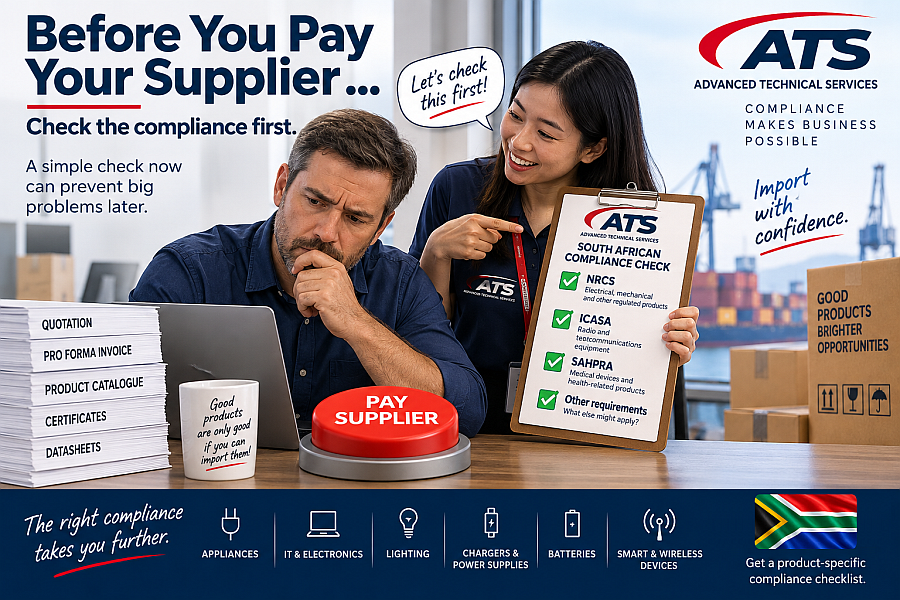
You have found the product. The price is good. The supplier looks legitimate. Samples have been approved. The pro forma invoice has arrived. All that remains is to pay the deposit and arrange shipping.
This is exactly the point where many South African importers should stop for one final check.
Not because there is necessarily anything wrong with the product. But because nobody has yet asked the most important question:
Can you legally import and sell it in South Africa?
The Expensive Way to Discover You Need an LOA
We regularly receive enquiries from importers after the goods have already been ordered. Sometimes the shipment is on the water. Sometimes it has arrived at the port. And sometimes it has already been stopped. Only then does somebody discover that the product requires an NRCS Letter of Authority (LOA), ICASA approval, SAHPRA authorisation or another form of South African regulatory compliance.
At that stage, the problem becomes considerably more expensive. Your supplier may have supplied CE certificates or other overseas approvals, but those documents do not automatically satisfy South African regulatory requirements. As we have discussed previously, South African compliance depends upon the applicable compulsory specification, standards, testing and supporting documentation for the particular product. The time to establish this is before you pay the supplier, not after the shipment arrives.
A Pro Forma Invoice Can Tell Us a Lot
An importer does not necessarily need a complete technical file before asking us to perform an initial assessment. A supplier’s quotation or pro forma invoice is often an excellent place to start.
Send us the product list together with whatever information the supplier has already provided — datasheets, photographs, catalogues, certificates or test reports.
We can then screen the proposed order and identify products that may require further investigation.
For example, a shipment that appears to contain mostly simple mechanical products might also contain:
- a battery charger;
- an AC/DC power supply;
- a mains-powered controller;
- a wireless remote control;
- a Wi-Fi or Bluetooth module;
- an electrical motor;
- a plug, socket or electrical accessory; or
- another regulated component.
That one overlooked item can change the compliance requirements for the shipment.
“My Supplier Says It Is Certified”
This is one of the most common statements we hear. The next question should always be:
Certified to what?
A CE mark, CB certificate, IEC test report, EMC report or overseas radio approval may be extremely useful. But the existence of a certificate does not, by itself, tell us whether the product is ready for the South African market. We need to establish things such as:
Does the report cover the exact product model?
Was the correct standard used?
Is the report still acceptable for the intended South African application?
Was the testing performed by an appropriately accredited laboratory?
Does the model number on the product match the model identified in the report?
Does the product contain wireless functionality requiring ICASA consideration?
Does the product require more than one South African approval?
Finding the answers before ordering gives you options. Finding them after the goods arrive gives you problems.
The Supplier May Already Have What You Need
A pre-import compliance review does not necessarily mean commissioning expensive new testing. Quite often, the manufacturer already has useful documentation. The problem is knowing what to ask for.
Instead of simply asking a Chinese supplier:
“Do you have South African certification?”
We can identify the likely regulatory route and help you ask for the actual technical documents required to assess the product. If suitable reports already exist, they may form the basis of the South African application. If something is missing, you will know that before placing the order. And if new testing is necessary, it can be discussed with the manufacturer before you commit to the product.
It Can Also Save Money on Testing
Compliance planning is not only about avoiding problems. Done properly, it can reduce costs.
If you intend importing several similar models, it may be possible to structure them as a product family so that appropriate testing covers multiple models rather than unnecessarily testing and applying for each one separately. We have previously explained how correctly structured product grouping can reduce laboratory and LOA costs. The important part is doing the planning before the testing begins. Once reports have been issued incorrectly, fixing them can be considerably more difficult.
What About Products That Don’t Need an LOA?
That is useful information too. The purpose of a pre-import review is not to find a regulatory requirement where none exists. If the products do not appear to fall within the relevant regulatory controls, we will tell you.
And where something needs further investigation, we can identify that before you commit to the shipment. The objective is simple:
Know what you are buying — and what South African compliance will require — before you pay for it.
A Better Way to Import
The traditional approach looks something like this:
Order → Pay → Ship → Arrive → Discover compliance problem → Panic
We prefer:
Select product → Check compliance → Verify supplier documents → Resolve gaps → Order → Ship
It is a small change in the order of events, and it can make an enormous difference to the cost and risk of importing.
Planning a New Import?
If you are considering a new supplier or preparing to place an overseas order, send us the supplier’s:
- quotation or pro forma invoice;
- product catalogue or links;
- datasheets;
- photographs; and
- any certificates or test reports already available.
Advanced Technical Services can carry out a Pre-Import Compliance Review to identify likely South African regulatory requirements before you commit to the shipment. Where necessary, we can then assist with the technical documentation, testing and applications required for NRCS, ICASA, SAHPRA or other applicable regulatory processes.
The cheapest compliance problem is the one you identify before the goods are purchased.
Stay compliant. Avoid delays. Protect your business.