
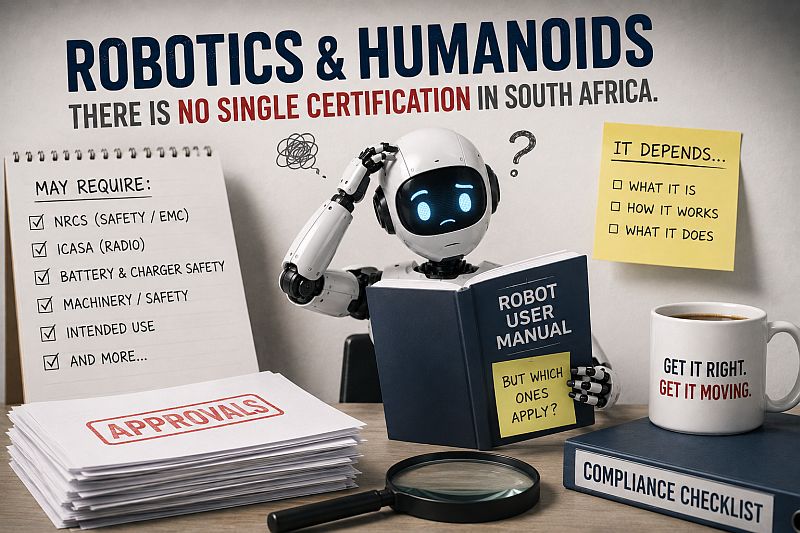
We recently received a short enquiry that simply read: “Robotics and Humanoids certification.”
It may well win the prize for maximum regulatory complexity expressed in three words.
As humanoid robots, service robots and collaborative robots begin to appear more frequently in South African homes, schools, warehouses and factories, importers and manufacturers are starting to ask the same question: What approvals do we actually need? The honest answer is that there is no single, generic “robotics” or “humanoid” certification in South Africa. The requirements depend entirely on the design, power source, communications features and intended use of the specific product.
What Usually Applies
Most robotics and humanoid products will trigger one or more of the following:
1. NRCS Letter of Authority (LOA)
If the product contains electrical or electronic components that fall under existing compulsory specifications (for example certain appliances, power supplies, chargers or motor-operated equipment), an LOA is required before it can be legally sold. The exact standard depends on the product’s classification. A power supply or charger often needs its own LOA even if the robot itself does not clearly fit an existing VC.
2. ICASA Type Approval
Any robot that incorporates Wi-Fi, Bluetooth, cellular, RFID or other radio communications will almost certainly require ICASA type approval. Cleaning/service robots and robotic lawnmowers already appear in regulatory classification discussions between ICASA and the NRCS. Radio functionality is one of the most common triggers we see.
3. Additional considerations based on use
- Educational or domestic robots may still need electrical safety and radio approvals.
- Industrial or collaborative robots may need to meet additional workplace safety expectations.
- Any product making medical or personal-care claims could attract SAHPRA requirements.
- Battery systems, chargers and docking stations frequently need separate scrutiny.
Why a Generic Certificate Does Not Exist
South African regulation is product- and function-based, not category-based in the way some people expect. A humanoid that walks, talks, connects to Wi-Fi and charges from a mains adaptor is treated as a combination of electrical appliance + radio equipment + (possibly) other regulated elements. Each element is assessed against the relevant compulsory specification or type-approval rules.
This is why a one-page “robotics certificate” from the country of origin, a CE declaration, or a general safety report is rarely sufficient on its own.
What We Need to Assess a Product Properly
To determine the correct pathway we typically ask for:
- Manufacturer and exact model number
- Product datasheet / technical specifications
- User manual (if available)
- Clear photographs or a product link
- Details of the power supply and charger
- Confirmation of any radio features (Wi-Fi, Bluetooth, cellular, etc.)
- Intended application (educational, domestic, commercial, industrial, etc.)
With this information we can map the product against current NRCS compulsory specifications and ICASA requirements and give clear advice on what is needed.
Looking Ahead
We expect enquiries of this nature to increase as more advanced robots and humanoids enter the South African market. The regulatory framework will continue to evolve, but the fundamental principle will remain the same: compliance is determined by what the product actually does and contains, not by the marketing label “robot” or “humanoid.”
If you are planning to import or distribute robotics or humanoid products, the earlier you clarify the regulatory position, the lower the risk of delays, detentions or non-compliance notices later.
At Advanced Technical Services we already assist clients with complex multi-regulator products. Robotics simply adds another layer of the same careful, product-specific analysis we apply every day.
Stay compliant. Avoid delays. Protect your business.