
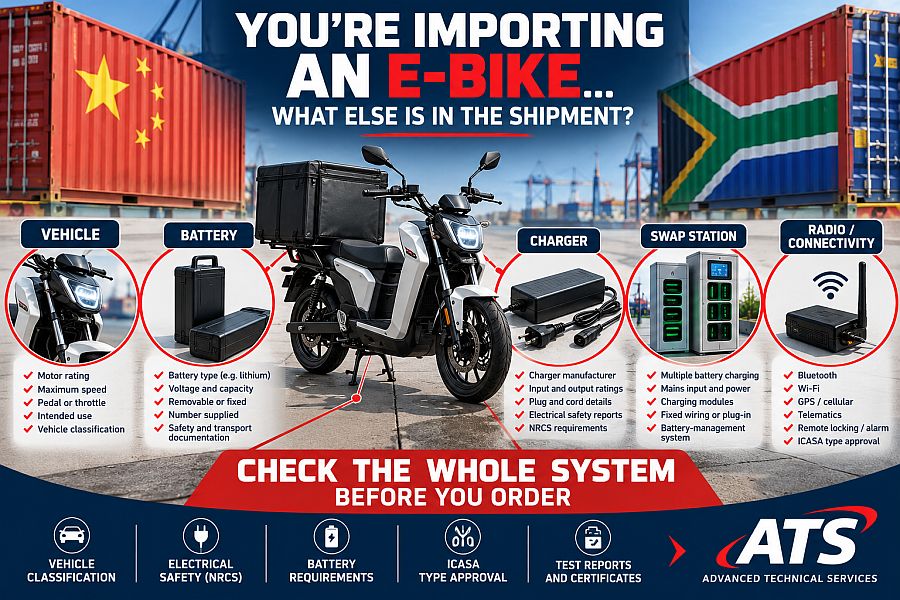
Electric two- and three-wheeler imports into South Africa are growing rapidly. But the compliance question can extend far beyond the vehicle itself — to batteries, chargers, battery-swapping stations and wireless equipment.
South Africa’s market for electric two-wheelers is becoming increasingly difficult for importers to ignore. Recent Chinese customs data reported by Business Day and TimesLIVE shows that South Africa imported 19,635 electric bikes from China during the first six months of 2026, worth approximately R111.3 million. This made South Africa the largest destination for these products in sub-Saharan Africa during the period. Business Day
For established businesses and entrepreneurs looking at the sector, the opportunity is obvious.
But before placing an order, there is another question worth asking:
What exactly are you importing?
An electric bike or motorcycle may be only one part of the shipment.
Depending on the product and the business model, the complete system could include the vehicle, removable lithium batteries, mains-powered chargers, battery-swapping equipment, tracking systems, wireless communications and other electrical or electronic accessories.
Each needs to be identified before the compliance requirements can be properly assessed.
An “e-bike” is not necessarily just an e-bike
Supplier terminology can be misleading.
Products described online as electric bikes, e-bikes, electric scooters or electric motorcycles can vary enormously in power, speed and construction.
That matters in South Africa.
The NRCS compulsory specification VC 9098 covers Category L motor vehicles designed or adapted for operation on public roads. However, it specifically excludes certain low-powered electrically assisted cycles: those with an auxiliary electric motor having a maximum continuous rated power of 0.25 kW, where assistance is progressively reduced and ultimately cut off by 25 km/h or sooner. NRCS
That means the specifications matter.
A 250 W pedal-assisted cycle meeting the relevant exclusion is not the same regulatory proposition as a 4 kW or 5 kW delivery motorcycle simply advertised by a supplier as an “e-bike”.
Before importing, establish at least:
- the exact manufacturer and model;
- maximum continuous motor power;
- maximum design or assisted speed;
- whether the vehicle has pedals;
- whether propulsion is pedal-assisted or throttle-controlled;
- the intended use of the vehicle; and
- whether it is intended to operate on public roads.
Do not rely on the supplier’s product description alone to determine the South African classification.
Then look beyond the vehicle
This is where an apparently simple import can become more complicated.
A battery-powered vehicle does not connect directly to the South African mains supply while it is being ridden.
But its battery has to get its electricity from somewhere.
That normally introduces charging equipment.
NRCS electrotechnical regulation covers a wide range of electrical and electronic products and components, with regulated products requiring approval before entering the South African market. The precise requirement depends on the equipment and the compulsory specification applicable to it. NRCS
So don’t stop your compliance assessment at:
“The bike runs on a battery.”
Ask:
“What charges the battery, and what exactly are we importing with it?”
Battery swapping doesn’t remove the charger
Battery swapping is becoming an important part of the commercial electric-motorcycle market.
Instead of waiting for a depleted battery to recharge, a delivery rider can exchange it for a charged battery and continue working.
That makes obvious commercial sense for a vehicle earning money throughout the day.
But from a compliance perspective:
Battery swapping doesn’t remove the charger. It moves the charging somewhere else — and potentially multiplies it.
A swapping operation may need several batteries for every vehicle in service. Those batteries still need to be charged, managed and made available for the next rider.
The charging equipment can therefore become substantially more complex than the small charger somebody might expect to find in an e-bike carton.
South African examples already demonstrate this distinction.
ARC Ride launched its Panther electric motorcycle and battery-swapping service in South Africa in September 2026, with swapping stations and hubs in Cape Town and Gauteng. Its local motorcycles use a 5 kW continuous-output motor and include telemetry, vehicle tracking and fleet analytics. Business Day
Other South African fleet systems offer removable batteries alongside fast and rapid chargers, some requiring dedicated high-power electrical supplies. Battery stations are also available that charge, manage and distribute multiple batteries. EWIZZ
For an importer planning a similar system, the question therefore isn’t simply:
Does the motorcycle comply?
It may also be:
What is inside the charging or battery-swapping station?
A swapping station may be infrastructure, not an accessory
Consider what a commercial battery-swapping system might contain:
Vehicles → removable batteries → multiple charging modules → battery-management equipment → mains electrical equipment → software and communications equipment
The station may charge several batteries simultaneously.
It may have a considerably higher electrical input than an individual vehicle charger.
It may require a dedicated electrical supply.
And it may communicate with riders, vehicles or a fleet-management platform.
At that point, describing it as an “e-bike accessory” does not tell you enough to assess its compliance.
The station needs to be understood as a product in its own right.
Don’t forget ICASA
Modern electric vehicles and fleet systems are increasingly connected.
Possible functions include:
- Bluetooth;
- Wi-Fi;
- GPS combined with cellular communications;
- vehicle tracking;
- telemetry;
- app-based access;
- remote locking or alarms; and
- wireless fleet-management systems.
ICASA requires electronic communications equipment and radio apparatus falling within its Type Approval regime to be approved unless an applicable exemption exists. ICASA
Again, the main purpose of the product is not the only consideration.
A motorcycle may principally be a vehicle, while also containing radio equipment.
A battery-swapping cabinet may principally charge batteries, while also containing cellular, Wi-Fi or Bluetooth communications.
The wireless functionality needs to be identified and assessed too.
“CE certified” doesn’t answer the South African question
A supplier may provide an impressive collection of documents.
You might receive a CE certificate, electrical safety report, EMC report, battery test documentation, UN 38.3 documentation or other certificates and declarations.
Some of these may be extremely useful.
But the existence of a folder full of certificates does not by itself establish that the complete product and all of its associated equipment meet the requirements applicable in South Africa.
The important questions include:
What was tested?
Which model was tested?
To which standard?
Which laboratory performed the testing?
Does the report cover the product actually being supplied?
And which South African regulatory requirement are we trying to satisfy?
Review what the supplier already has before ordering additional testing.
Ask what’s actually coming in the shipment
Before ordering electric bikes, scooters or motorcycles, ask the supplier for enough information to understand the complete system, not merely the headline product.
A useful starting list includes:
- exact manufacturer and model numbers;
- product photographs and rating plates;
- motor rating and maximum speed;
- battery manufacturer, model, voltage, capacity and chemistry;
- whether batteries are fixed or removable;
- number of batteries supplied per vehicle;
- charger manufacturer and model;
- charger input and output ratings;
- plug, cord and mains-connection details;
- electrical safety reports;
- details of all Wi-Fi, Bluetooth, cellular, GPS or other radio functions;
- available radio and EMC reports;
- existing vehicle approval or homologation documentation;
- battery transport and safety documentation; and
- details of any charging or battery-swapping infrastructure included in the project.
For a battery-swapping operation, add:
- number of batteries charged simultaneously;
- maximum mains input of the station;
- charging-module details;
- fixed-wiring or plug-in arrangement;
- battery-management system information;
- station controller details; and
- all communications technologies used by the station.
And ask one very simple question:
Are we importing only the vehicles, or the complete charging and swapping ecosystem?
The answer can change the compliance work considerably.
Why this matters now
The African electric two-wheeler market is developing in different ways.
Some markets are seeing increasing imports of complete Chinese vehicles, while others are developing local assembly, commercial motorcycle fleets, charging infrastructure and battery-swapping networks. The recent trade data shows that South Africa is already a significant destination for Chinese electric two-wheelers. Business Day
Battery swapping is particularly attractive for high-utilisation commercial vehicles because riders do not need to wait while their batteries recharge. But the infrastructure supporting that convenience becomes part of the wider technical and regulatory picture. Business Day
For South African importers, that creates both an opportunity and a reason to conduct proper due diligence before committing to a supplier.
Before you pay, check the whole system
A supplier quotation headed “Electric Motorcycle” may eventually turn into a shipment containing much more than motorcycles.
The vehicle may raise automotive regulatory questions.
The charger or charging station may introduce electrotechnical requirements.
The communications equipment may introduce ICASA requirements.
The batteries bring their own technical, safety and transport documentation.
And a commercial battery-swapping operation may combine all of those elements in one project.
None of this means that electric bikes or battery-swapping systems should be avoided.
It means they should be understood before they are ordered.
At Advanced Technical Services, we would rather examine the specifications, supplier documents and proposed system before an importer pays for the goods than discover an overlooked compliance requirement once the shipment has already left China.
Before you pay your supplier, check the compliance first — and check everything that is coming with the product.
Stay compliant. Avoid delays. Protect your business.
Compliance Help — LOA/ICASA/test-report explanations
Before You Pay Your Supplier — pre-purchase checking