
PREVIOUS UPDATES
March 2026 — New CoC Requirement for Imports from China: What South African Importers Need to Know
June 2026 — New CoC Requirement for Imports Paused
August 2026 — Further Details on the Paused PVoC Programme
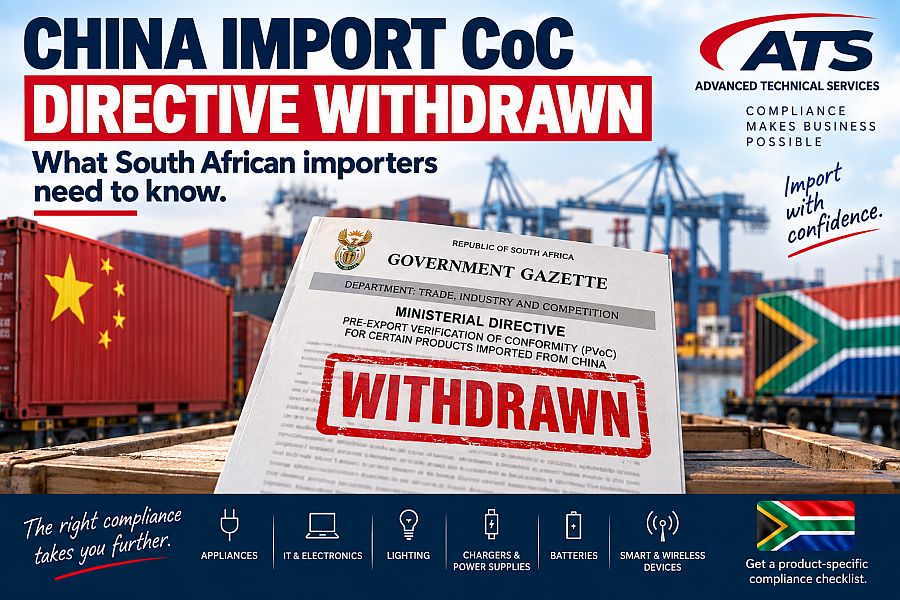
The proposed Pre-Export Verification of Conformity programme is no longer simply paused. The original ministerial directive has now been formally withdrawn.
South African importers following the proposed new Certificate of Conformity requirements for certain imports from China finally have a clearer answer.
On 22 September 2026, Minister of Trade, Industry and Competition Parks Tau formally withdrew the ministerial directive that would have introduced the Pre-Export Verification of Conformity (PVoC) programme for certain unregulated products imported from China.
The withdrawal took effect immediately upon publication in the Government Gazette. Any applications still pending under the programme are to be administratively closed. Government of South Africa
This is the latest — and most decisive — development in a process ATS has been following since March.
How we got here
In March 2026, we reported on the new ministerial directive proposing a Certificate of Conformity requirement for a broad range of currently unregulated products imported from China.
The original directive was quite specific about its scope. It applied to products not already subject to compulsory specifications administered by the NRCS, and expressly stated that it did not replace or limit the mandate of the NRCS or other regulators. Government of South Africa
In June, implementation of the programme was paused.
In our subsequent August update, we explained that SABS and the DTIC had extended consultation following feedback received through the World Trade Organisation’s Technical Barriers to Trade (WTO/TBT) process, discussions with the Chinese Embassy and submissions from industry stakeholders.
At that stage, the programme was still described as paused rather than cancelled.
That position has now changed.
The March directive has been withdrawn
Government Notice 7947 withdraws the original March ministerial directive in its entirety.
This means the proposed PVoC Certificate of Conformity requirement contained in that directive will not take effect.
For importers, the immediate position is therefore straightforward:
You do not need to obtain a PVoC Certificate of Conformity under the withdrawn March 2026 directive.
Pending applications under that programme are also to be administratively closed. PGH Attorneys
Why was it withdrawn?
This is where some caution is necessary.
Recent media reports have described the decision as a backtrack following opposition from China. There is certainly evidence that China’s concerns formed part of the consultation process.
The programme had been designed initially around imports from China. SABS’s original public notice described China as the Phase 1 pilot country, citing its importance as a source of South African consumer imports, identified compliance risks and the availability of conformity-assessment infrastructure in China. SABS also stated at the time that the pilot was intended eventually to expand to other countries. SABS
By June, however, the programme had been suspended while issues raised through the WTO/TBT process, consultation with the Chinese Embassy and industry feedback were considered. China’s Ministry of Commerce subsequently published the South African suspension notice, including the reference to consultations with the Chinese Embassy. Ministry of Commerce of China
Recent reporting says a Chinese complaint concerned the programme’s country-specific scope. Sunday Times
There were also practical concerns.
Customs specialists quoted by Moneyweb raised questions about how a country-specific system could operate using tariff classifications that do not always distinguish between the individual products included in the PVoC list. They also questioned the practicality of detaining goods according to country of origin using existing Customs controls. Moneyweb
However, the formal withdrawal notice itself does not state why the programme was withdrawn, and DTIC had not publicly clarified the reason or whether a replacement programme is planned when the latest reports were published. Sunday Times
It would therefore be premature to say simply that China “forced South Africa to withdraw” the programme.
What does this mean for importers?
For products that fell only within the proposed PVoC programme, the additional Certificate of Conformity requirement contemplated by the March directive has now fallen away.
But there is an important distinction:
The withdrawal of PVoC does not remove existing South African product compliance requirements.
The original directive itself specifically excluded products already subject to NRCS compulsory specifications and stated that it did not replace the mandates of existing regulators. Government of South Africa
So, for example, a product requiring an NRCS Letter of Authority does not cease requiring an LOA because PVoC has been withdrawn.
Likewise, products subject to ICASA, SAHPRA or other existing South African regulatory requirements remain subject to those requirements.
The withdrawn programme was intended to introduce an additional system for certain products that were not already regulated in this way.
That distinction is important.
Could PVoC come back?
At present, we don’t know.
Earlier SABS documentation envisaged the Chinese programme as the first phase of a wider system that could later extend to additional countries and product categories. SABS
That was before the consultation process and subsequent withdrawal.
As of the withdrawal, there has been no confirmed replacement programme announced, and DTIC had not clarified whether the directive might eventually be reissued in another form. Sunday Times
It remains possible that South Africa could consider a differently structured conformity-verification system in future.
Importers should, however, work from the requirements currently in force, rather than trying to anticipate what might replace the withdrawn programme.
The underlying problem hasn’t disappeared
Perhaps the most interesting part of this story is that withdrawing the mechanism does not remove the problem it was intended to address.
The PVoC proposal was designed to move conformity checking further upstream — before goods were shipped to South Africa.
SABS described the objective as preventing high-risk, unregulated products from reaching South Africa without first being assessed against applicable standards. SABS
That principle remains significant.
As we discussed recently in our article “Why Surprise Raids Alone Won’t Stop Non-Compliant Goods in South Africa”, finding unsafe or non-compliant products once they are already on shop shelves is detection rather than prevention.
For legitimate importers, the same principle applies on a much smaller scale.
Discovering a compliance problem before paying a supplier is easier than discovering it before shipment.
Discovering it before shipment is easier than discovering it when the container reaches Durban.
And discovering it at the port is considerably better than discovering it after the product has already entered the market.
What should importers do now?
The withdrawal means importers should not arrange PVoC certification merely because their products appeared on the March 2026 list.
But pre-import compliance checking remains just as important.
Before placing an order, establish what requirements actually apply to the product being imported.
That may include checking:
- whether an NRCS compulsory specification applies;
- whether an NRCS LOA is required;
- whether Wi-Fi, Bluetooth, cellular or other radio functionality introduces ICASA requirements;
- whether another South African regulator applies;
- what standards are relevant;
- what test reports and certificates the supplier already holds; and
- whether those documents actually cover the models being ordered.
The regulatory question is therefore back to where it should always have started:
What does this particular product require before I import it into South Africa?
The ATS view
The PVoC story has changed considerably since the original directive was published in March.
First announced.
Then paused.
Then subjected to further consultation.
Now formally withdrawn.
We will continue to monitor whether any replacement or differently structured programme is proposed.
In the meantime, the practical advice for South African importers remains unchanged:
Before you pay your supplier, check the compliance first.
If you are considering a new product, send us the supplier’s quotation or pro forma invoice, product information and whatever compliance documentation they already have.
It is much easier to establish what is required before the goods are ordered and shipped than after they arrive in South Africa.