
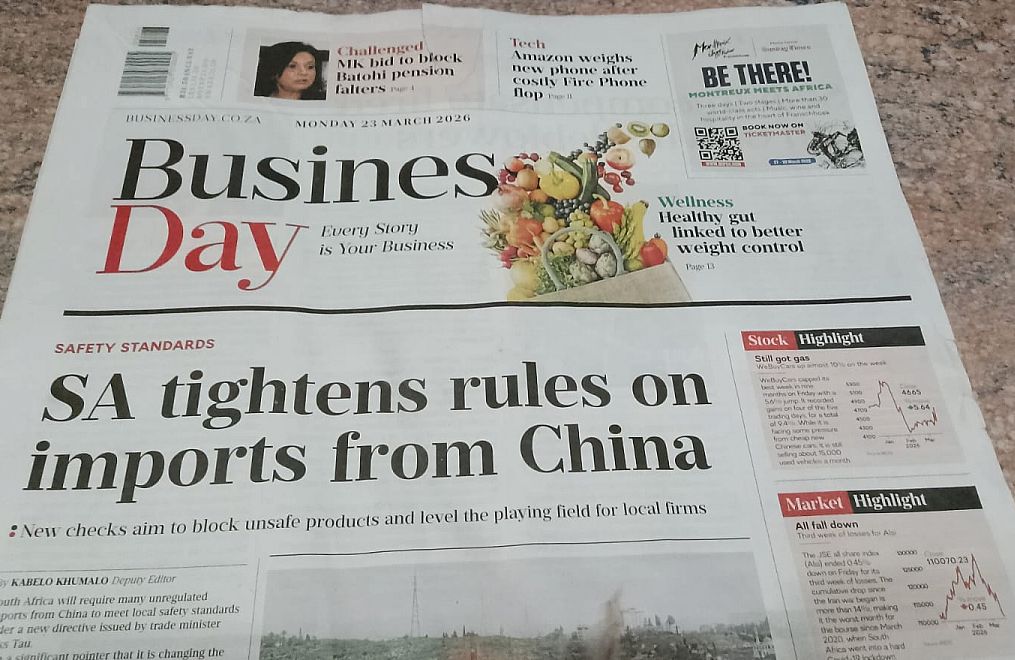
The South African government is intensifying its crackdown on sub-standard and non-compliant imports, with a strong focus on goods originating from China. Recent announcements have introduced stricter enforcement of the Certificate of Conformity (CoC) requirement for many product categories. This development directly affects importers, clearing agents, and businesses bringing goods into South Africa.
If you import electrical products, electronics, appliances, lighting, power tools, or any items falling under compulsory specifications (VCs), this change is highly relevant to you.
A wide range of products imported from China will soon require specialised certification before they can enter South Africa.
According to a Government Gazette published by the Department of Trade, Industry and Competition (DTIC), importers will now need to provide a Certificate of Conformity (CoC) for these goods.
The move is driven by growing concerns that many unregulated products entering the country from China do not meet local quality and safety standards.
While the requirement applies only to “certain unregulated products”, a detailed list of affected categories is expected to be published in the coming weeks. This list will include items that are currently not subject to compulsory specifications under the relevant national regulators.
Commonly imported goods likely to be affected include clothing and textiles, footwear, leather goods, handbags, toys, baby products, and kitchenware.
For example, baby clothing sold in South Africa must now carry accurate fibre content labelling (such as “100% cotton”), proper care instructions, and any required thermal hazard warnings. All such products will need to be accompanied by a valid Certificate of Conformity (CoC) confirming they meet the relevant South African National Standards (SANS) or other recognised reference standards.
What is the Certificate of Conformity (CoC)?
Under the National Regulator for Compulsory Specifications (NRCS), certain products must comply with South African National Standards (SANS). The CoC is official proof that the imported goods meet these standards.
There are two main certificates you will encounter:
- LOA (Letter of Authority) – Issued by the NRCS for compulsory safety and performance specifications (VCs). This is mandatory for regulated products before they can be sold in South Africa.
- CoC (Certificate of Conformity) – Often required for electromagnetic compatibility (EMC), safety testing, or other specific standards. It is issued by accredited laboratories or bodies such as SABS or approved third-party testing facilities.
The latest enforcement push makes it clear that customs will increasingly demand valid CoC/LOA documentation at the point of entry. Goods arriving without the correct certification risk being held, seized, or refused entry.
Which Products Are Affected?
The requirement primarily targets:
- Products covered by specific compulsory specifications (VCs) published by the NRCS
- Many categories of consumer goods previously imported with minimal checks
The focus is on low-cost imports that do not meet South African safety and quality standards, particularly those flooding the market from certain Chinese manufacturers.
How Will This Affect Importers?
- Increased Documentation Requirements You must now obtain a valid CoC/LOA before shipping. This means arranging testing and certification in the country of origin or through an accredited lab.
- Local Agent Requirement Only a South African-registered company (or authorised local agent) can hold the LOA/CoC. Overseas manufacturers cannot apply directly.
- Delays and Costs Expect longer lead times and higher costs due to testing, certification fees, and possible rework of products that fail initial tests.
- Risk of Seizure or Penalties Non-compliant shipments can be detained at the border. In serious cases, goods may be seized, destroyed, or returned at the importer’s expense. Repeated offences can lead to fines or blacklisting.
- Supply Chain Changes Many importers will need to review and possibly change suppliers or require their Chinese factories to obtain proper certification upfront.
Practical Steps for Importers
- Verify whether your product falls under any compulsory VC specification on the NRCS website.
- Engage an accredited testing laboratory (local or international, ILAC-accredited) to conduct the required tests.
- Appoint or use a South African registered agent to apply for the LOA/CoC.
- Ensure all shipping documents clearly reference the certificate numbers.
- Build buffer time into your import schedule — certification can take several weeks or even months.
- Work only with suppliers who understand and can provide the necessary test reports and declarations of conformity.
How Advanced Technical Services Can Help
We have been assisting importers with NRCS compliance, LOA applications, CoC coordination, and product testing for several years. Our team can guide you through the entire process — from identifying which standards apply to your goods, to arranging testing, and submitting applications on your behalf.
If you are currently importing from China or planning new shipments, now is the time to review your compliance status.
Contact us today for a no-obligation discussion on how the new CoC requirements will affect your specific products.
Email: dion@advancedtechnicalservices.co.za
Stay compliant. Avoid delays. Protect your business.