The 140th Canton Fair takes place in Guangzhou from 15 October to 4 November 2026, across three separate exhibition phases. For South African buyers, knowing which phase to attend is only the beginning. The products on display can raise very different regulatory questions — and some of the biggest problems may arise before the goods even leave China.
The Canton Fair is one of the world’s largest trade exhibitions, bringing together Chinese manufacturers, exporters and international buyers across an enormous range of industries.
For South African businesses, it offers opportunities to discover new products, compare manufacturers, negotiate prices and establish direct supplier relationships.
But there is a practical distinction that is easy to overlook.
Finding a product you want to import is not the same as establishing that you can legally import and sell it in South Africa.
And, increasingly, there is another question worth asking: can your supplier arrange a properly documented export from China?
The answers depend on what you are buying, who is supplying it, and how the transaction will be handled.
Canton Fair 2026: The Three Phases
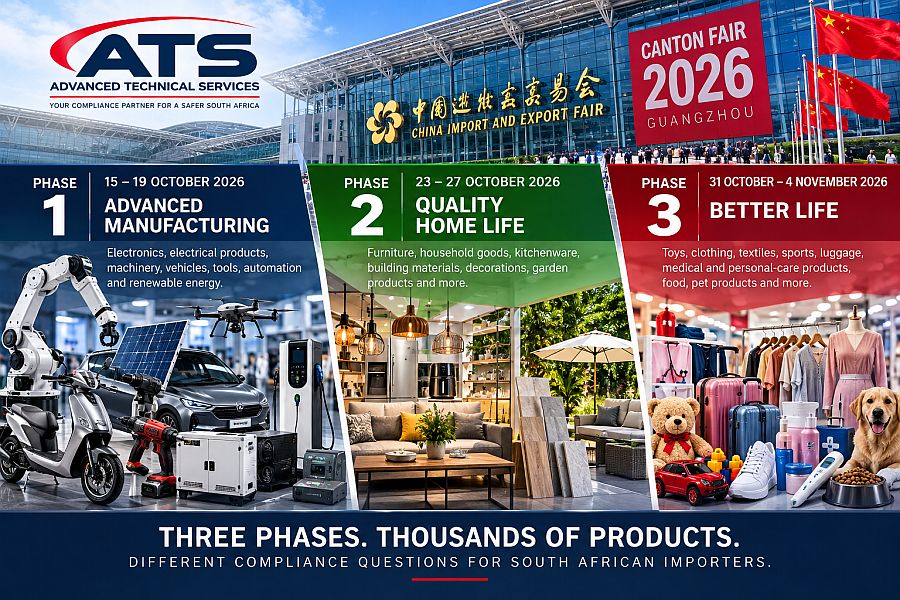
The 140th Canton Fair is divided into three five-day exhibition periods, each concentrating on different product categories.
| Phase | Dates | Main focus |
|---|---|---|
| Phase 1 | 15–19 October 2026 | Advanced manufacturing, electronics, machinery, vehicles and energy |
| Phase 2 | 23–27 October 2026 | Household goods, furniture, building materials and decorations |
| Phase 3 | 31 October–4 November 2026 | Clothing, toys, medical and personal-care products, sports and consumer goods |
The exhibition takes place at the China Import and Export Fair Complex in Guangzhou.
There are three-day intervals between the phases, so visitors planning to attend more than one should account for these gaps when arranging travel and supplier meetings.
Importantly, the exhibition category is not a regulatory classification. A product appearing in a particular hall does not automatically tell you which South African requirements apply.
Phase 1: Technology, Machinery, Electrical Products and Vehicles
15–19 October 2026
Phase 1 is particularly relevant to businesses sourcing technical and industrial products.
The official exhibition categories include household electrical appliances, consumer electronics, industrial automation, manufacturing equipment, construction and agricultural machinery, electrical equipment, lighting, renewable-energy products, vehicles, motorcycles, bicycles, hardware and tools.
There is also a dedicated service-robot exhibition area.
For South African importers, this phase can present several different regulatory considerations.
Electrical products and appliances
Products connected to mains electricity may fall within an applicable NRCS compulsory specification.
Depending on the product, this could involve an NRCS Letter of Authority (LOA), appropriate safety testing and supporting technical documentation. However, the presence of an electrical connection does not automatically mean that every product requires the same approval. A household appliance, industrial machine, battery charger and electronic control device may need to be assessed differently.
The important starting point is the product’s actual function, electrical characteristics and intended use.
Wireless technology is often hidden inside other products
A product does not have to be marketed as a wireless device to introduce ICASA considerations.
Industrial controllers, smart-home products, security equipment, robots, agricultural equipment and other devices may incorporate Wi-Fi, Bluetooth, cellular communication or radio-frequency remote controls. These features can introduce Type Approval requirements in addition to any applicable product-safety requirements.
An NRCS approval and an ICASA approval address different regulatory questions. One does not automatically replace the other.
Vehicles and electric mobility
Phase 1 also includes electric vehicles, motorcycles, bicycles and other mobility products.
South African requirements can differ considerably depending on vehicle classification, intended road use, power and design. And the vehicle may be only part of the shipment. Battery chargers, removable batteries, charging stations, wireless controls and other associated equipment can introduce additional considerations.
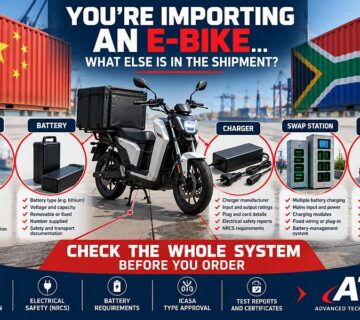
We have covered this particular issue in more detail in our article, Importing Electric Bikes from China? Check the Whole System Before You Order.
Machinery and industrial equipment
Industrial machinery presents another common misunderstanding.
A manufacturer may describe a machine as CE-certified, but that statement alone does not establish its South African regulatory position. The assessment needs to consider the complete equipment, its intended application and the specific regulatory requirements that may apply. An industrial machine should not automatically be treated as a household appliance, nor should it automatically be assumed to fall outside all product regulations.
Phase 1 takeaway: Technical products often contain more than one potential compliance issue. Assess the complete product and its functions, not simply the name printed in the catalogue.
Phase 2: Household Goods, Furniture and Building Products
23–27 October 2026
Phase 2 moves into products associated with homes, interiors, construction and everyday living.
Exhibition categories include furniture, kitchenware, ceramics, glassware, household items, home decorations, garden products, gifts, building and decorative materials, sanitary equipment and prefabricated housing products. At first glance, these products may appear less complicated than the electrical equipment in Phase 1.
But that can create a different problem: buyers may assume that products without an obvious plug have no regulatory requirements.
Building products require particular attention
Certain construction materials and products can fall under South African compulsory specifications or other applicable regulatory requirements.
A decorative product and a structural or safety-critical building product are not necessarily treated alike.
Importers should establish precisely what the product is, how it will be used and whether any applicable standard or approval is compulsory.
Household products are becoming increasingly electrical
Furniture, mirrors, bathroom equipment, garden products and decorative items increasingly incorporate electrical or electronic features.
Examples include illuminated mirrors, powered furniture, electrically operated fittings, smart controls and decorative lighting. These features may change the regulatory assessment substantially.
A supplier’s description of an item as furniture or decoration does not remove the need to examine its electrical functions.
Products that look similar may be regulated differently
Two products can appear almost identical in a showroom while having different technical characteristics, intended uses or regulatory classifications.
This is particularly important when importers are considering multiple models, sizes or variations from the same supplier.
Phase 2 takeaway: Do not assume that household, furniture or decorative products are automatically outside the scope of compulsory requirements. The actual product and its intended use matter.
Phase 3: Toys, Clothing, Health Products and Consumer Goods
31 October–4 November 2026
Phase 3 covers an extensive range of consumer-facing products.
The official categories include toys, baby and maternity products, clothing, footwear, textiles, luggage, office supplies, sports and recreational equipment, medical devices, health products, personal-care products, food and pet products.
The regulatory questions here can be very different from those encountered in Phase 1.
Toys and children’s products
A product intended for children deserves careful scrutiny, particularly where it incorporates electrical components, batteries, chargers or wireless functions.
The correct assessment depends on the product’s characteristics and applicable South African requirements.
A toy, a powered ride-on product and a road-going electric vehicle should not automatically be treated as belonging to the same regulatory category.
Medical devices and health products
Products marketed for medical, diagnostic or therapeutic purposes may fall within the regulatory scope of the South African Health Products Regulatory Authority (SAHPRA).
This can involve requirements beyond ordinary product testing, including establishment licensing, product classification and other applicable regulatory processes. The supplier’s description of an item as a wellness product does not necessarily determine its regulatory status.
Importers should pay particular attention to intended use and medical claims.
Cosmetics, personal care and other consumer products
Personal-care products, cosmetics, food and other consumer goods can introduce regulatory considerations outside the usual NRCS electrical-product approval process.
Different authorities and legal frameworks may apply depending on the product. This is an important reminder that South African product compliance is not limited to electrical safety or wireless equipment.
Phase 3 takeaway: A product does not need a power cable to be regulated. Intended use, ingredients, claims and consumer-safety requirements may be just as important as electrical specifications.
The Overlooked Question: Can Your Supplier Actually Export the Goods?
There is another issue that applies across all three phases, regardless of whether you are buying machinery, furniture, clothing or electronic products.
Who is actually going to export your goods from China?
It is easy to assume that a factory displaying products at an international trade exhibition can automatically arrange their export.
But manufacturing goods, selling them to an overseas customer and completing the export transaction are not necessarily the same activity.
Does every Chinese factory need its own export licence?
Not in the way this question is sometimes understood.
China abolished its former general foreign-trade operator registration requirement in December 2022. However, that change did not eliminate Customs registration and declaration requirements, applicable export controls or the need for accurate export documentation. A Chinese manufacturer may export directly or use a legitimate export trading company or agent.
The important question is whether the arrangement is properly established and accurately documented.
When using an export agent becomes a problem
China permits legitimate export agency arrangements.
But buyers should distinguish these from practices sometimes described in Chinese as 买单出口 (mǎi dān chū kǒu), commonly associated with buying or borrowing another company’s export declaration identity. In a problematic arrangement, an unrelated company may appear as the exporter on the paperwork without the underlying transaction being accurately represented. This can create Customs and tax-compliance risks.
China has also tightened reporting requirements relating to export agency transactions. From 1 October 2025, new corporate income-tax reporting provisions require export agents to identify the actual Chinese party commissioning the export and report the relevant export amounts.
These changes make it particularly important for freight forwarders, trading companies and manufacturers to understand who is responsible for the export and how the transaction must be declared.
What South African buyers should establish
Before paying a supplier, clarify whether the manufacturer will export directly or whether a separate trading company will handle the transaction.
Where a third party is involved, establish its role, the identity of the actual Chinese seller or manufacturer and whether the arrangement will be correctly reflected in the export documentation. Also establish whether the particular goods require additional Chinese export-control permissions. A legitimate export agent can be a perfectly acceptable solution. An arrangement that relies on misrepresenting the actual exporter is not an acceptable shortcut.
And buyers should not assume that a freight forwarder can resolve every export-documentation problem after the goods have already been manufactured.
Before asking whether South Africa will allow the goods in, make sure China can lawfully send them out.
A Successful Canton Fair Visit Is Only the Beginning
The Canton Fair is an excellent opportunity to meet suppliers, examine products and identify new commercial opportunities.
But a convincing demonstration, attractive price or impressive catalogue is only part of the sourcing decision. For South African importers, there are several separate questions to resolve:
-
Commercial: Is the supplier credible, and are the price, quality, quantities and delivery arrangements suitable?
-
Chinese export arrangements: Who will legally export the goods, and are any special permissions required?
-
South African product compliance: Which compulsory specifications, approvals or other regulatory requirements apply?
-
Documentation: Are the relevant reports, certificates, model details and technical documents available and suitable for the intended application?
These questions should be addressed before an order becomes difficult or expensive to change.
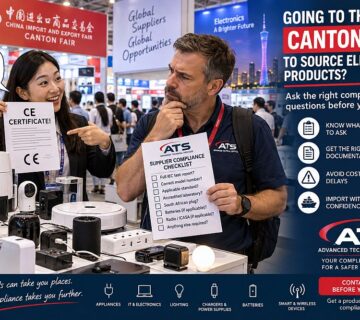
For a more detailed explanation of the documentation worth requesting from suppliers, see our earlier article, Going to the Canton Fair?.
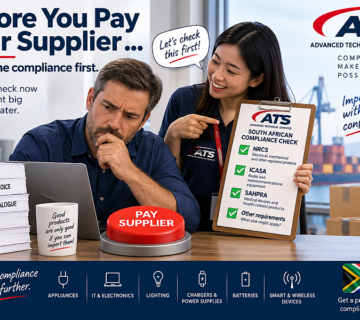
We also explain the benefits of reviewing a supplier’s quotation and technical documents before committing to an order in Before You Pay Your Supplier: Check the Compliance First.
Three Phases. Many Products. No Single Compliance Answer.
The three phases of the Canton Fair make it easier for buyers to find the industries and products they are interested in. They do not divide South African regulatory requirements into three convenient categories. A product’s compliance position depends on what it is, what it does, how it will be used and which legal requirements apply.
Likewise, a supplier’s ability to manufacture a product does not, by itself, establish that the export transaction is properly arranged. The best time to resolve these questions is while you are still evaluating the supplier — not when the shipment is waiting at a Chinese port, arriving in Durban or being examined by a South African regulator.
The Canton Fair can help you find your next product. Understanding the requirements on both sides of the shipment helps you turn that opportunity into a workable import.