Why the most valuable part of product compliance often happens long before an application reaches the NRCS.
There’s a fairly common misconception among importers that obtaining an NRCS Letter of Authority (LOA) is primarily an administrative exercise. Find a company that handles applications, send them the manufacturer’s certificates, pay the necessary fees and wait for approval.
If only it were that simple.
At Advanced Technical Services (ATS), we regularly receive enquiries from importers who already have certificates, test reports and assurances from their overseas suppliers that their products comply with international standards. Some have even been told that their products are fully approved for the South African market. Unfortunately, those assurances don’t always survive closer examination.
And that’s where the real work begins.
The Application Is Often the Easy Part
Submitting an LOA application is a defined administrative process. There are forms to complete, documents to upload, fees to pay and correspondence to manage. But before any of that happens, someone needs to establish whether the product actually requires an LOA, which compulsory specification applies, and whether the available technical documentation is suitable.
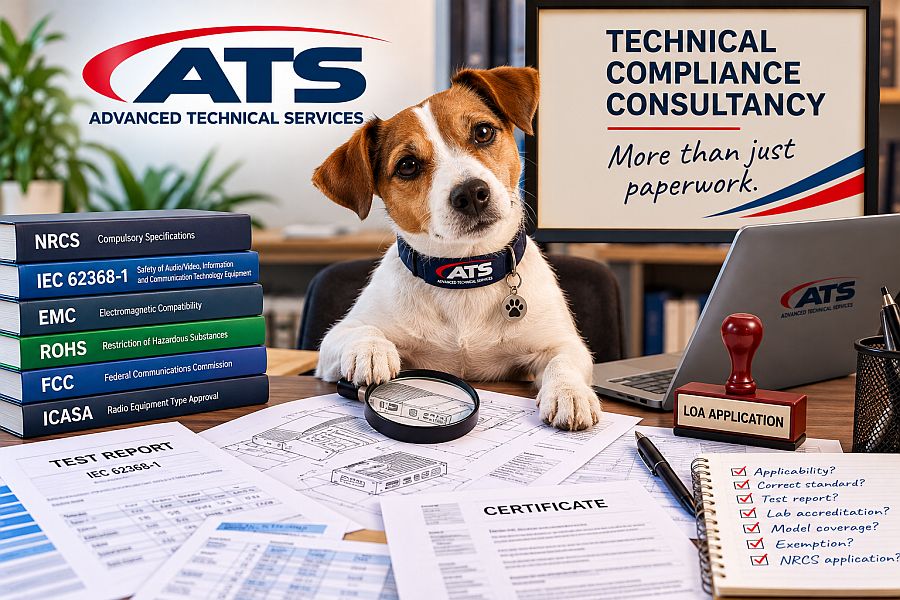
That may sound straightforward, but consider some of the questions that regularly arise during our assessments. Does the manufacturer’s test report cover the exact model being imported? Was the testing performed by an appropriately accredited laboratory? Does the laboratory’s accreditation scope include the relevant standard? Is the report sufficiently recent for the intended application?
If several models are being imported, can they be covered by the same test report, or will additional testing be required? Does the product fall within the scope of a compulsory specification at all?
And what happens when a supplier provides a perfectly genuine certificate that simply doesn’t demonstrate compliance with the requirements applicable in South Africa? These are technical and regulatory questions, not administrative ones.
Getting the answers wrong can result in rejected applications, unnecessary testing expenses, delayed shipments and considerable frustration.
Sometimes the Best Advice Is Not to Apply
This is an aspect of compliance consultancy that is frequently overlooked. Not every electrical or electronic product imported into South Africa requires an NRCS Letter of Authority.
The applicable requirements depend on the nature of the product, its intended use, its electrical characteristics and the scope of the relevant compulsory specifications. Some products may fall outside a particular specification. Others may qualify for an exclusion, while certain circumstances may justify investigating whether a formal exemption is available.
Importantly, these are not interchangeable concepts. An exclusion from the scope of a compulsory specification is not the same as an exemption granted by the regulator. Determining the correct position requires examining the actual equipment and the applicable regulatory provisions. An importer who proceeds directly to an unnecessary application could spend money on testing, certification and administration that might have been avoided. Equally, assuming that a product is exempt simply because it is intended for industrial use, or because it will not be sold to the public, can create serious compliance problems.
The most valuable advice we provide is not always how to obtain an approval. Sometimes, it is establishing whether that approval is required in the first place.
A Certificate Is Not Necessarily a Compliance Solution
We have written previously about the importance of obtaining proper test reports rather than relying on certificates alone. The distinction is particularly important when dealing with overseas manufacturers. A supplier may provide a CE certificate, an IEC certificate, an EMC report or documentation relating to a different model within the same product family.
These documents may be entirely genuine and still be insufficient for the intended NRCS application. A certificate might refer to a test report that has not been supplied. A report may identify a different manufacturer, cover a different product configuration or reference a standard that does not satisfy the applicable South African requirements. Sometimes the problem is more subtle.
A test report may cover an entire family of products, but the relationship between the tested samples and the specific models being imported is not adequately documented. Resolving these questions often requires direct correspondence with the manufacturer, testing laboratory or certification body.
In some cases, supplementary testing or a formal technical clarification may be necessary. None of this involves completing an LOA application form. Yet it can determine whether that application ultimately succeeds.
Why We Charge for Initial Compliance Assessments
When a business consults an attorney, accountant or professional engineer, it generally understands that the initial examination of a problem is itself a professional service.
The client is paying for knowledge, experience, analysis and judgement. Technical product compliance should be no different.
An initial compliance assessment may involve examining technical specifications, interpreting compulsory specifications, reviewing test reports, verifying accreditation and identifying the most appropriate regulatory route. It may also reveal that further information is required before a reliable conclusion can be reached. This work takes time and requires specialist knowledge.
For that reason, ATS treats an initial compliance assessment as a separate, chargeable professional service rather than simply an introductory step towards an LOA application. The assessment fee is not a payment for a guaranteed approval. It is a payment for the technical work required to establish the appropriate course of action.
Where subsequent applications, laboratory testing or extended regulatory correspondence are necessary, those services can then be quoted separately. This approach also gives clients a clearer understanding of what they are paying for and why.
Good Compliance Advice Can Save More Than It Costs
Consider an importer preparing to order several models of electrical equipment from an overseas manufacturer. The supplier provides a collection of certificates and assures the importer that everything is ready for the South African market.
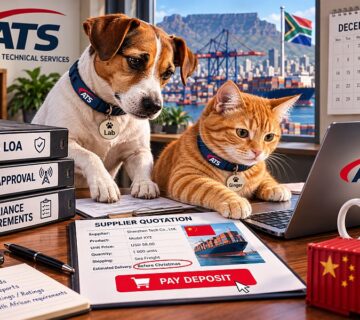
Without a proper assessment, the importer might place the order, arrange shipping and only discover the documentation problems when an LOA application is rejected or the goods encounter difficulties at the border. By that stage, the costs may extend far beyond the original testing or application fees.
Storage charges, shipping delays, additional testing, supplier disputes and lost business opportunities can quickly become expensive. A technical assessment conducted before the order is finalised may identify these problems while there is still time to resolve them. It may also establish that existing documentation can be used, that certain models can be grouped appropriately, or that a different compliance route is more suitable. Of course, an assessment cannot guarantee that every subsequent regulatory issue will be avoided.
But it can substantially reduce the risk of making expensive decisions based on incomplete or unsuitable information.
We’re Not Simply Processing Paperwork
There is nothing wrong with providing an efficient LOA application service. Administrative accuracy and experience with the regulator’s procedures are important. But the service ATS provides extends beyond submitting applications.
Our work includes technical documentation assessment, product classification, interpretation of applicable compulsory specifications, communication with manufacturers and testing laboratories, and assistance with regulatory enquiries. We help clients understand what documentation they need, why they need it and what must happen before an application can proceed.
Sometimes that leads to an NRCS LOA application. Sometimes it leads to additional testing or clarification from the manufacturer. And sometimes the assessment establishes that the product falls outside the scope of the particular approval requirement being investigated.
In each case, the objective is the same: to help the importer make an informed decision based on the applicable technical and regulatory requirements.
Start With the Assessment, Not the Application
If you’re planning to import electrical or electronic equipment into South Africa, the best time to investigate compliance is before placing your order or arranging shipment. Gather the manufacturer’s technical specifications, exact model numbers, available test reports and certificates, and details of how the equipment will be used. Then have the documentation assessed against the applicable South African requirements.
You may discover that everything is already in order. You may identify a relatively simple documentation issue that can be resolved before shipment. Or you may uncover a more substantial compliance problem that would have been considerably more expensive to address later. Whatever the outcome, you’ll be making your next decision with a better understanding of the requirements.
At Advanced Technical Services, we don’t simply ask which LOA you want us to apply for. We first establish whether you need one, and what it will take to comply.
Because the most valuable thing a technical compliance consultant can provide isn’t always an approval.
Sometimes, it’s the knowledge that you never needed to apply for one in the first place.