Why South African importers should think of regulatory compliance as a business asset, not simply another expense.
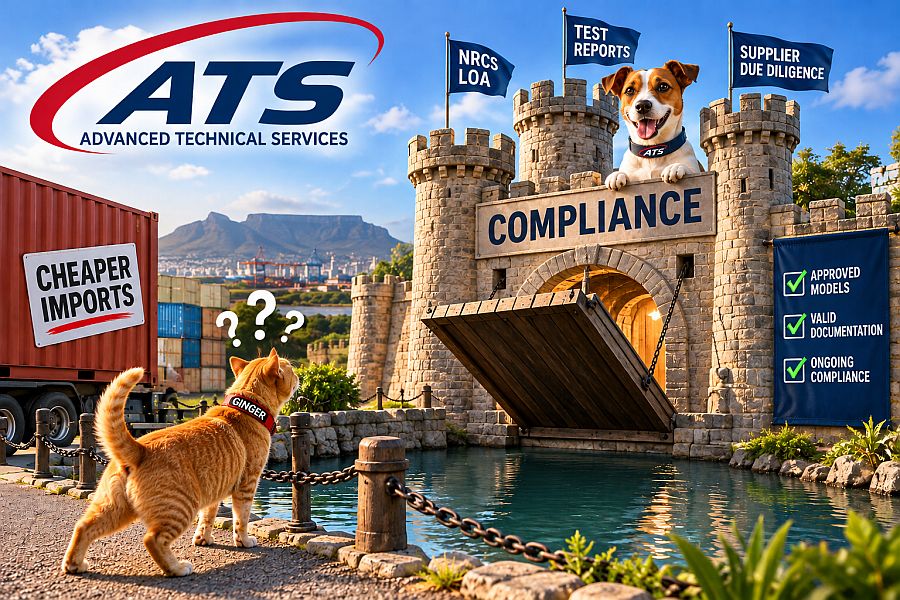
In business circles, there’s a popular expression: building a moat. The idea is straightforward. Just as a moat once protected a castle from unwanted visitors, a business can develop advantages that make it more difficult for competitors to challenge its position. These advantages might include a recognised brand, exclusive distribution arrangements, established customer relationships or specialist technical knowledge.
But for South African importers, there is another potential advantage that often receives surprisingly little attention: regulatory compliance.
More specifically, where a product falls under an applicable compulsory specification, obtaining the necessary NRCS Letter of Authority (LOA) can represent considerably more than permission to place that product on the market. Handled properly, it can become part of a genuine competitive advantage.
The competitor who hasn’t done the homework
Imagine two South African companies planning to import similar electrical products. Company A has already established which compulsory specifications apply, obtained the necessary test documentation from its manufacturer and secured the relevant NRCS approval. Its products are covered by a valid LOA, its supplier understands the compliance requirements, and the company has procedures to ensure that subsequent shipments remain consistent with the approved products.
Company B discovers what appears to be an identical product from another overseas manufacturer, at a substantially lower price. The opportunity looks attractive. Company B negotiates a favourable price, places an order and starts approaching potential customers. Only then does someone raise an awkward question:
Does this product require an NRCS Letter of Authority?
If it does, Company B may suddenly face a process it hadn’t anticipated: obtaining suitable test reports, establishing whether those reports are acceptable, confirming the exact models covered and submitting an application for approval. If the documentation is inadequate, additional testing may be necessary.
Meanwhile, Company A already has the groundwork in place. The difference isn’t necessarily the product, its price or even its quality. It’s preparation.
Compliance creates a barrier — but not a monopoly
This is where the business moat analogy becomes useful. South Africa’s compulsory specifications establish requirements that regulated products must satisfy before they may lawfully be imported, sold or supplied, as applicable. An importer who has already satisfied those requirements may therefore enjoy a practical advantage over a competitor who has yet to begin.
But there’s an important distinction.
An NRCS LOA does not grant an importer exclusive rights to a particular product or market.
Other businesses are free to obtain their own approvals, provided they satisfy the applicable requirements. Nor does an LOA automatically protect every product in a supplier’s catalogue. Approval applies to the specified products and models, subject to the relevant conditions. The advantage comes from having completed the necessary work, understanding the requirements and being ready to operate within them. A competitor can build the same capability. It simply cannot assume that the work is unnecessary.
The value of being ready to supply
Importers understandably spend considerable time negotiating prices, shipping arrangements and payment terms. Yet the ability to supply products reliably can be just as important as the purchase price.
Consider a distributor choosing between two potential suppliers. One can provide appropriate evidence that the relevant products are covered by a valid LOA. The other offers a slightly lower price but cannot yet establish whether its products meet the applicable regulatory requirements. For a distributor concerned about continuity of supply, product compliance and potential regulatory interruptions, that difference may matter.
The same principle can apply to retailers, commercial buyers and organisations with formal procurement procedures. Being able to substantiate the compliance status of a product can help establish confidence. That doesn’t mean an LOA is a guarantee of product quality or an endorsement by the NRCS. It is regulatory authorisation relating to the applicable requirements.
Nevertheless, demonstrable compliance can be a meaningful commercial asset.
The advantage extends beyond the certificate
A well-managed compliance process involves considerably more than obtaining an LOA number.
An experienced importer may already have established:
-
Which compulsory specifications apply to its products.
-
Which test standards and supporting reports are required.
-
Whether the manufacturer’s laboratory documentation is suitable.
-
Which models and variations are covered by an approval.
-
How changes in product design, components or manufacturing arrangements could affect compliance.
-
When approvals expire and when renewal preparations should begin.
This knowledge becomes part of the company’s operating capability. It can help the importer evaluate new suppliers, assess additional product ranges and identify potential problems before committing substantial money to an overseas order. In other words, the real competitive advantage isn’t simply the certificate.
It’s the compliance knowledge, supplier relationships and processes developed around it.
A moat needs maintenance
Of course, a competitive advantage can disappear if it isn’t maintained. An importer might hold an LOA for a particular model but subsequently source a modified version that falls outside the original approval. A supplier might change a critical component, move production to another factory or introduce a new model designation.
An approval might expire while the importer is concentrating on other parts of the business. And changes to regulatory requirements can create new obligations. A company that treats its LOA as a document to be filed away and forgotten may eventually find itself facing the same difficulties as a new entrant. Maintaining the advantage requires ongoing attention to product specifications, approval conditions, supplier changes and renewal dates.
Compliance isn’t a once-off achievement. It’s an ongoing business responsibility.
Can compliance become part of your sales proposition?
There is nothing inherently wrong with helping customers understand that a product has the appropriate regulatory approval.
Where relevant, an importer can make the applicable LOA documentation available to prospective business customers and explain which products and models are covered. The important point is accuracy. An LOA should not be presented as a blanket approval of an entire product range if only particular models are covered. Nor should regulatory authorisation be confused with a general quality certification or an official product endorsement.
But a company that can clearly demonstrate its regulatory preparedness may be better placed to reassure buyers who are concerned about sourcing compliant products. For businesses supplying regulated equipment, that reassurance can have genuine commercial value.
From compliance expense to business investment
It’s easy to view testing, technical documentation and LOA applications as additional costs that make importing more expensive.
And they certainly involve time, effort and money. But that is only one side of the equation. A properly managed compliance process can reduce avoidable regulatory uncertainty, support more dependable sourcing decisions and help protect the continuity of supply. It can also put an established importer in a stronger position when competing against businesses that have not yet understood their obligations.
This doesn’t mean that the most compliant company will necessarily be the most successful, or that an LOA guarantees a commercial advantage. Price, service, product suitability, availability and customer relationships still matter enormously. What compliance can do is remove a significant source of uncertainty while giving the importer another reason to be taken seriously.
Where Advanced Technical Services fits in
At Advanced Technical Services (ATS), we work with South African importers to help them understand the regulatory requirements applicable to their products and navigate the documentation and approval processes.
This includes assessing available test reports, identifying potential documentation gaps, clarifying model coverage and assisting with NRCS Letter of Authority applications. Our objective is not simply to help clients obtain an approval and move on. It’s to help them approach importing with a clearer understanding of the compliance requirements, ideally before orders are placed and shipments are dispatched.
Because the best time to discover a compliance problem is before it becomes an expensive one.
A moat, not a monopoly
Regulatory compliance should never be mistaken for a way to prevent legitimate competitors from entering a market.
South Africa’s compulsory specifications exist to establish mandatory requirements, not to grant established importers permanent protection from competition. But businesses that invest in understanding and meeting those requirements may gain something valuable: preparedness, continuity and credibility. And in a competitive market, those advantages should not be underestimated.
You cannot stop a competitor from meeting the same standards. But you can make sure you’re not the one playing catch-up.
Advanced Technical Services assists South African businesses with NRCS Letters of Authority, ICASA Type Approval and related product compliance requirements. Visit advancedtechnicalservices.co.za to learn more.