致中国供应商:请不要再随意发送各种证书了!
Why South African importers need actual test reports — and why a collection of impressive-looking certificates may not be enough.
For South African Importers:
Struggling to obtain the correct test reports from your Chinese supplier? You’re welcome to share the link to this article directly with them. A complete Simplified Chinese translation appears below the English version, explaining why South African compliance applications require specific technical documentation — and why certificates alone may not be sufficient. Simply send your supplier this page and ask them to read the Chinese section.
ENGLISH VERSION
The familiar email exchange
A South African importer asks a Chinese supplier a straightforward question: “Can you please provide the test report for this product?”
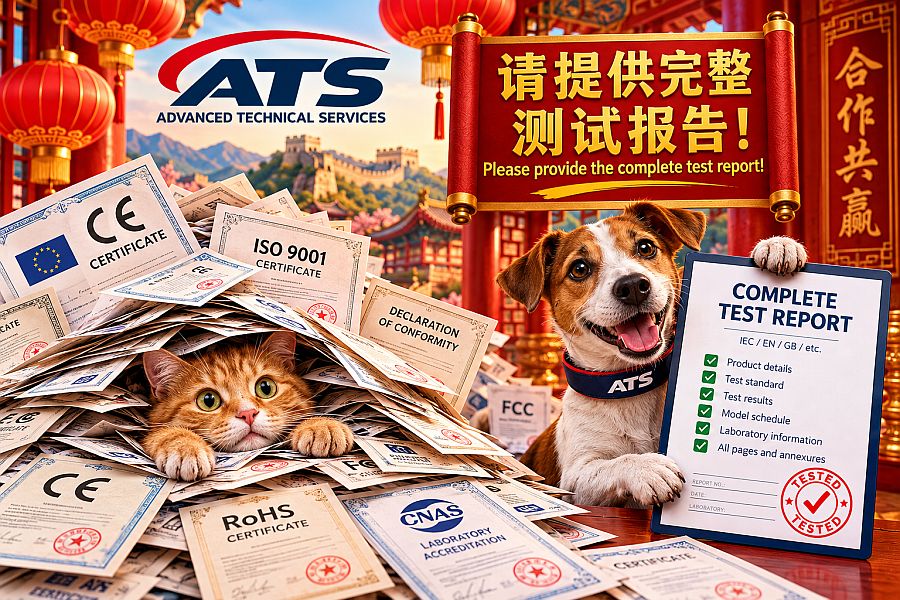
The supplier responds enthusiastically. Attached are a CE certificate, an ISO 9001 certificate, a declaration of conformity, a certificate for a similar product and perhaps a photograph of a testing laboratory’s accreditation certificate.
The importer asks again: “Thank you, but we need the actual test report.”
Another certificate arrives.
Sometimes it is for a different manufacturer. Sometimes it covers a different model. Occasionally, it relates to an entirely different product. And sometimes the supplier assures the importer that the documents are sufficient because the products have already been exported to Europe. Unfortunately, none of this necessarily answers the original question.
A certificate and a test report are not the same thing
This distinction is fundamental. A certificate may confirm that a product, manufacturer or management system meets particular requirements under a specified certification scheme. A test report records the actual testing performed on a product against a particular standard.
Depending on the applicable standard and testing programme, a report may include:
-
The name and address of the manufacturer and applicant.
-
The product description and exact model identification.
-
The applicable test standard and its edition.
-
The laboratory responsible for testing.
-
The test procedures, measurements and results.
-
Photographs, ratings, component information and relevant technical details.
-
The conclusions and any deviations or limitations.
Not every report contains all these elements in the same format. What matters is whether it provides the technical evidence required for the particular South African approval. A certificate may be entirely genuine and still be insufficient for that purpose.
“But we already have CE!”
This is one of the most common misunderstandings. CE marking relates to applicable European Union regulatory requirements. It is not, by itself, an approval to import or sell a regulated product in South Africa. A CE declaration or certificate does not automatically replace the technical test reports required for an NRCS Letter of Authority (LOA).
That does not mean European testing is worthless. A properly issued IEC or EN test report from a suitably accredited laboratory may provide valuable supporting evidence, depending on the product, applicable compulsory specification and the requirements of the relevant South African authority.
But ATS needs to examine the actual documentation before determining whether it is suitable.
The manufacturer’s name matters
Imagine that the importer orders a product from Company A. Company A sends a certificate issued to Company B.
When questioned, the supplier explains: “Company B is our sister company.”
Or:
“Both companies belong to the same owner.”
That may be perfectly true. However, common ownership does not automatically establish that a report issued to one legal entity covers products manufactured or supplied by another. The relationship between the companies, the manufacturing facility, the product identification and the original testing documentation may all need to be established.
Sometimes a manufacturer declaration, authorised documentation or laboratory confirmation can resolve the issue. Sometimes additional testing or certification is necessary. The correct answer depends on the evidence — not simply on the assurance that the companies are related.
A laboratory accreditation certificate is not a product test report
Another frequent misunderstanding concerns laboratory accreditation. A supplier may send a CNAS or other accreditation certificate to demonstrate that a laboratory is accredited. That can be useful information, but it does not prove that the particular product was tested, or that the testing fell within the laboratory’s relevant accredited scope.
The actual report must be examined, including its issuing laboratory, applicable standards, test dates, product identification and any relevant accreditation information. An accredited laboratory and an acceptable product test report are related concepts, but they are not interchangeable.
The problem with similar models
A supplier might provide a report for Model ABC-100 when the importer intends to purchase Model ABC-200. The products may look identical. They may even use many of the same components.
But visual similarity is not evidence that the second model is covered by the first model’s test results. Some standards and certification programmes permit model families, representative testing or documented technical variations. Where this is allowed, the relationship must be supported by appropriate documentation. If a model is not covered, further assessment or supplementary testing may be required.
The objective is not to demand unnecessary testing. It is to establish exactly what the existing evidence covers.
What South African importers should request
Before paying a deposit or arranging shipment, importers should establish which South African regulatory requirements apply to the intended product. Where test reports are required, ask the supplier for the complete original report, including all pages, annexures and model schedules. Then verify that the documents correspond to the actual product being ordered.
A useful initial request to a Chinese supplier is:
Please provide the complete product safety test report, including all pages and annexures, for the exact model we intend to import into South Africa. Please also provide the corresponding certificate, where applicable, and confirm the legal manufacturer, manufacturing address and any model variations covered by the report. If the report is issued under another company name, please explain the relationship and provide supporting documentation.
For wireless products, additional radio-frequency and other applicable technical documentation may be needed for ICASA Type Approval.
Different product categories have different requirements. There is no single certificate or test report that automatically covers everything.
A message to our Chinese suppliers
South Africa is an important market for Chinese manufacturers, and many suppliers work hard to provide reliable products and documentation. But sending an assortment of certificates does not necessarily help your South African customer. It can delay regulatory assessment, complicate import planning and create unnecessary costs for both parties.
If the customer asks for a test report, please send the actual test report. If it is unavailable, explain why. If the report belongs to another company, explain the relationship. If a model has not been tested, say so. Clear information at the beginning is far more useful than another certificate arriving three weeks later.
The bottom line
The right document is more valuable than ten unrelated certificates.
At Advanced Technical Services, we assist South African importers and their overseas suppliers in assessing product documentation, identifying applicable regulatory requirements and preparing NRCS and ICASA applications.
Our objective is straightforward: establish what is required before goods are shipped, rather than discovering a documentation problem when they reach South African customs.
中文版本(简体中文)
致中国供应商:请不要再随意发送各种证书了!
为什么南非进口商需要完整的产品测试报告,以及为什么一大堆证书未必能够满足南非的合规要求。
一个经常发生的邮件往来
南非进口商向中国供应商提出一个简单的问题:
“请提供该产品的测试报告。”
供应商很快回复,并附上多份文件:
CE证书、ISO 9001证书、符合性声明、类似型号的证书,甚至还有检测实验室的资质认可证书。
进口商再次说明:
“谢谢,但我们需要的是产品的完整测试报告。”
结果,又收到一份证书。
有时证书属于另一家制造商;有时证书对应不同型号;有时甚至与准备进口的产品完全无关。
供应商可能还会解释:
“我们的产品已经出口欧洲,所以这些证书应该可以使用。”
遗憾的是,这些资料并不一定能够满足南非的合规要求。
证书和测试报告不是同一种文件
这是一个非常重要的区别。
**证书(Certificate)**通常用于证明产品、制造商或管理体系在某个特定认证制度下符合相关要求。
**测试报告(Test Report)**则记录产品按照特定标准进行测试的实际过程和结果。
根据适用标准及测试项目,完整测试报告通常可能包含:
-
制造商及申请人的名称和地址;
-
产品描述及准确的型号;
-
所采用的测试标准及版本;
-
执行测试的实验室;
-
测试项目、测量数据和测试结果;
-
产品照片、电气参数、关键元器件及相关技术资料;
-
测试结论、偏差及适用范围说明。
不同标准的报告格式可能有所不同,关键是报告能否提供南非相关审批所需的技术证据。
证书即使真实有效,也不代表它一定能够替代完整测试报告。
“但是我们已经有CE认证!”
这是最常见的误解之一。
CE标志涉及欧盟适用的法规要求,并不意味着产品自动获得南非市场准入资格。
CE符合性声明或相关证书,不能自动代替申请南非NRCS批准函(Letter of Authority,简称LOA)所需要的技术测试报告。
当然,这并不意味着欧洲测试报告没有价值。
如果产品具有由具备适当资质的实验室出具的IEC或EN测试报告,该报告可能具有重要参考价值。
但是否能够用于南非审批,仍取决于产品类别、适用的强制性规范以及南非主管机构的具体要求。
因此,必须先审核完整文件。
制造商名称必须对应
假设南非进口商向A公司采购产品。
但A公司提供的证书却属于B公司。
供应商解释:
“B公司是我们的兄弟公司。”
或者:
“两家公司属于同一个老板。”
这些解释可能完全属实。
但是,两家公司拥有相同股东或实际控制人,并不自动证明B公司的测试报告可以覆盖A公司生产或供应的产品。
我们可能需要进一步确认:
-
两家公司的法律关系;
-
实际制造工厂;
-
产品及型号是否一致;
-
原始测试报告的适用范围;
-
是否需要制造商声明、授权文件或实验室确认。
某些情况下,补充证明文件即可解决问题。
另一些情况下,则可能需要重新测试或认证。
最终应以可核实的技术证据为依据,而不能仅凭口头说明。
实验室认可证书不是产品测试报告
有些供应商会提供CNAS等实验室认可证书。
这类文件可以证明实验室具有某些认可资质,但并不能单独证明某个具体产品已经完成测试,也不能证明相关测试项目属于实验室的认可范围。
必须审核实际产品测试报告,并确认:
-
报告签发实验室;
-
测试标准;
-
报告日期;
-
产品及型号;
-
相关认可范围和其他适用信息。
实验室具有认可资质,与具体产品具有符合要求的测试报告,是两个不同的问题。
类似型号不一定能够共用报告
例如,供应商提供ABC-100型号的测试报告,但南非客户准备进口的是ABC-200型号。
两款产品外观可能完全一样,甚至使用相同的主要元器件。
但这并不自动证明ABC-200已经包含在ABC-100的测试范围内。
部分标准及认证制度允许系列型号、代表型号测试或经过技术评估的型号差异。
如果适用,必须提供能够证明型号覆盖关系的文件。
如果现有报告没有覆盖相关型号,则可能需要进一步技术评估或补充测试。
我们的目的不是要求供应商进行不必要的重复测试,而是明确现有报告究竟覆盖哪些产品。
南非进口商应该要求什么资料?
在支付订金或安排发货之前,进口商应先确认产品适用的南非法规及审批要求。
如需测试报告,应要求供应商提供:
完整的原始产品测试报告,包括全部页面、附件及型号清单。
同时核实报告是否对应实际采购的产品。
以下是一段可以直接发送给中国供应商的中文要求:
请提供我们计划进口到南非的准确产品型号所对应的完整产品安全测试报告(Test Report),包括全部页面及附件。如适用,请同时提供对应的认证证书,并确认法定制造商名称、实际生产地址,以及报告覆盖的所有型号和变型。
如果测试报告使用的是另一家公司的名称,请说明两家公司的关系,并提供相关证明文件。
请注意:我们需要的是完整测试报告,而不仅仅是CE证书、符合性声明或实验室认可证书。
对于带有无线通信功能的产品,申请南非ICASA型号批准时,还可能需要无线射频测试报告及其他相关技术资料。
不同产品类别适用不同要求,不存在一份能够自动满足所有南非审批要求的通用证书。
致中国供应商的一段话
南非是中国制造商的重要出口市场,许多中国供应商一直努力提供可靠的产品和技术文件。
但是,发送大量不同的证书,并不一定能够帮助南非客户完成合规审核。
相反,这可能导致审批延误、进口计划受阻,并给双方带来额外成本。
客户要求测试报告时,请提供实际测试报告。
如果没有,请如实说明。
如果报告属于另一家公司,请解释两者之间的关系。
如果相关型号尚未测试,请明确告知。
在项目初期提供准确、完整的信息,远比三周后再发送一份不相关的证书更有帮助。
最后,请记住
一份正确的测试报告,比十份不相关的证书更有价值。
Advanced Technical Services(ATS)为南非进口商及其海外供应商提供产品合规文件审核、适用法规分析,以及NRCS和ICASA审批申请方面的专业协助。
我们的目标很简单:在货物发运之前确认合规要求,而不是等货物抵达南非海关后才发现文件存在问题。