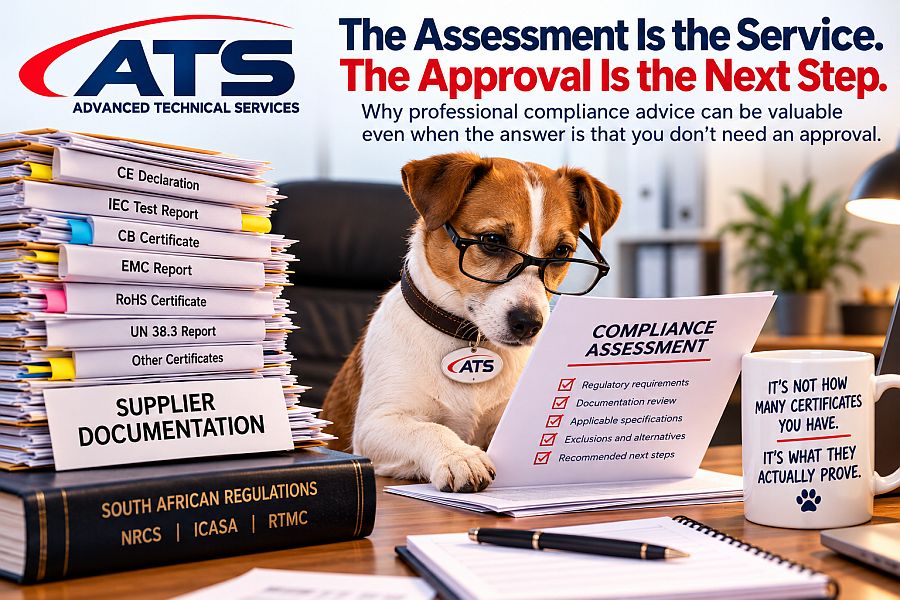
Why professional compliance advice can be valuable even when the answer is that you don’t need an approval.
An importer contacts a compliance consultant with what appears to be a straightforward question: “I want to import this product into South Africa. How much will it cost to obtain an NRCS Letter of Authority?” It’s a reasonable question. Unfortunately, it may be the wrong one to ask first.
Before anyone can provide a meaningful answer, there are several other questions to consider. Does the product fall within the scope of an NRCS compulsory specification? If so, which specification applies? Does the product qualify for an exclusion? Are there other regulatory requirements? And, perhaps most importantly, does the manufacturer’s documentation actually describe the product the importer intends to purchase? Answering those questions is not simply administrative preparation for an LOA application.
It is the compliance assessment itself — and it is a professional service.
What Are You Actually Paying For?
Consider what happens when you consult an attorney. You don’t expect the attorney to investigate your case, research the applicable legislation, review your documents and establish your legal position before discussing professional fees. The consultation and investigation are part of the service you’re paying for.
The same principle applies to an engineer examining a structure, an accountant reviewing a company’s tax position, or a technical consultant determining whether imported equipment complies with South African regulations. In each case, the professional is being paid to apply specialised knowledge to a particular set of circumstances. Import compliance is no different.
An experienced consultant may recognise a potential problem within minutes of examining a product description. But recognising the problem is only the beginning. Establishing the correct regulatory position may require detailed technical documentation, examination of test reports, interpretation of compulsory specifications and correspondence with manufacturers or regulatory authorities. Sometimes the answer is straightforward. Sometimes it takes considerably longer.
The value lies in reaching a properly supported conclusion, not in the number of forms eventually submitted.
Sometimes the Best Answer Is That You Don’t Need an LOA
There is a common misconception that a successful compliance exercise must end with an approval certificate. That isn’t necessarily true.
A product may fall outside the scope of a particular compulsory specification. It may qualify for an exclusion, or its regulatory obligations may relate to a specific component rather than the complete product. Alternatively, an importer may discover that an entirely different regulatory process applies. In such circumstances, submitting an unnecessary LOA application would accomplish very little.
A professional assessment that establishes why an application isn’t required can save an importer considerable time, money and frustration. Of course, there is an important distinction between a consultant’s technical opinion and an official determination by a regulatory authority. Where the circumstances require formal confirmation, that may need to be obtained separately. Nevertheless, a carefully researched assessment provides the importer with a much better basis for deciding how to proceed.
An assessment that concludes an LOA isn’t required has not failed to produce a result. That conclusion is the result.
The Certificate That Doesn’t Tell the Whole Story
Another frequent source of confusion is the manufacturer’s collection of certificates and test reports. An importer may receive a CE declaration, an IEC test report, a CB certificate or several other impressive-looking documents and reasonably assume that the product has already been tested and approved.
Unfortunately, the presence of a certificate doesn’t automatically establish that the particular product being imported complies with South African requirements. The documentation may refer to an earlier model, a different power supply, an alternative controller or a component that has subsequently been replaced.
The report may cover only certain aspects of the equipment, or it may have been issued by a laboratory whose accreditation needs to be verified for the relevant testing. Even a genuine, technically sound report may not support the specific application the importer has in mind.
A proper compliance assessment examines the relationship between the documentation, the applicable requirements and the actual equipment. That is very different from simply checking whether a certificate exists. And it can be particularly important when a manufacturer has modified a product without updating its supporting technical documentation.
One Product Can Present Several Different Compliance Questions
A further complication is that the regulatory position of a complete product may not be the same as that of every component supplied with it. Consider an electrically assisted bicycle. Depending on its technical characteristics, the bicycle itself may qualify for an exclusion from a particular vehicle compulsory specification. However, that does not automatically resolve the requirements applicable to its mains-powered battery charger, the safety and transport documentation for its lithium-ion battery, or the rules governing its use on public roads.
Those are separate questions, potentially involving different regulations and authorities. Similarly, equipment supplied with an external power adapter may require an assessment of the adapter’s electrical safety obligations even where the main device operates entirely at extra-low voltage. This is why a simple answer to the question “Does it need an LOA?” can sometimes be misleading.
The correct answer may be that one approval is unnecessary, another requirement still applies, and further technical information is needed before a final conclusion can be reached. An assessment identifies those distinctions before the importer commits to a particular course of action.
Why the Assessment Should Come Before the Application
It is tempting to begin with the application process, particularly when a supplier is waiting for an order or a shipment is approaching its departure date. But applying for an approval before establishing the correct regulatory position can create unnecessary complications.
The importer may discover that the available test reports are unsuitable, that the product differs from the tested configuration, or that additional laboratory work is required. In some cases, the equipment may need to be modified. In others, the anticipated approval may not be necessary at all. These are matters best identified before money is committed to testing, applications or international shipping.
A professional assessment does not guarantee that a product will be approved, that Customs will release a shipment, or that every regulatory question can be resolved immediately. What it does provide is a structured examination of the available information, identification of the relevant requirements, and a reasoned explanation of the next steps. That is a considerably better starting point than submitting an application and hoping the documentation will be accepted.
Professional Advice Has Value Before There Is an Approval
Importers understandably want certainty about costs and timelines. A compliance consultant may be able to provide an initial indication of the likely regulatory issues, but a reliable conclusion often requires substantially more work.
Reviewing technical reports, checking model traceability, investigating exclusions and communicating with laboratories or regulatory authorities are not incidental administrative tasks. They are the technical work required to establish the importer’s position. And that work has value regardless of whether the eventual recommendation is to apply for an LOA, obtain additional testing, seek formal clarification or proceed without a particular approval.
A professional assessment may identify a problem that prevents an expensive mistake. It may reveal a less complicated compliance route. Or it may confirm that the manufacturer’s documentation is suitable and that an application can proceed. All three are useful outcomes.
The Approval Is the Next Step — If One Is Required
At Advanced Technical Services, our objective is not to generate unnecessary applications. It is to help importers understand and address the technical compliance requirements applicable to their products. That begins with establishing what the product is, what regulations apply, and whether the available evidence supports compliance. Only then can the appropriate next steps be determined.
Sometimes that means preparing an NRCS LOA application. Sometimes it means obtaining additional test reports or resolving discrepancies with a manufacturer. And sometimes it means explaining, with appropriate supporting reasoning, why a particular approval is not required.
The assessment is the service. The approval, where required, is the next step.
Because sometimes the most valuable compliance document isn’t an approval certificate.
It’s the assessment that explains why you don’t need one.