How South Africa’s port congestion affects importers — and why a delayed container can become a much more expensive problem than expected.
A container leaves a factory in China. The supplier has been paid. The shipping documents are in order. The importer has calculated the landed cost, arranged the necessary financing and perhaps already committed to delivery dates with customers.
The vessel reaches Durban. And then it waits.
Not necessarily because anything is wrong with the goods. Not because Customs has rejected the declaration. Not because an NRCS approval is missing. It waits because the port is struggling to handle the containers already arriving.
For the importer, however, the distinction offers little comfort. The goods are still unavailable. Customers are still waiting. The business still has bills to pay. And depending on the circumstances, additional costs may already be accumulating.
A shipping delay is not simply an inconvenience. It can fundamentally change the economics of an import transaction.
Durban’s Latest Warning
In November 2026, renewed concerns about operations at Durban Gateway Terminal brought South Africa’s port difficulties back into sharp focus. The terminal, formerly known as Durban Container Terminal Pier 2, is a particularly important part of the country’s container logistics network.
Its operations have been undergoing significant changes following the introduction of International Container Terminal Services Inc. (ICTSI) as a private-sector operating partner. The arrangement was intended to introduce expertise, investment and improvements in terminal performance. Instead, the transition has encountered serious difficulties.
Problems associated with the introduction of a new terminal operating system, equipment limitations and continuing backlogs have contributed to substantial delays. The Southern African Association of Freight Forwarders (SAAFF) reported in mid-November that congestion was adding approximately 20 days to affected supply chains, with numerous vessels still waiting at anchorage. The situation has become serious enough for major manufacturers to report financial consequences. Automotive components manufacturer Metair has highlighted production interruptions, shortages of imported materials and the considerable expense of using air freight to maintain supply.
Durban Gateway Terminal has acknowledged the disruption and outlined equipment investments and operational improvements intended to address the problems. But for businesses waiting for their goods, the immediate question is not who will ultimately resolve the situation.
It is how long they can afford to wait.
The Costs That Don’t Appear on the Supplier’s Invoice
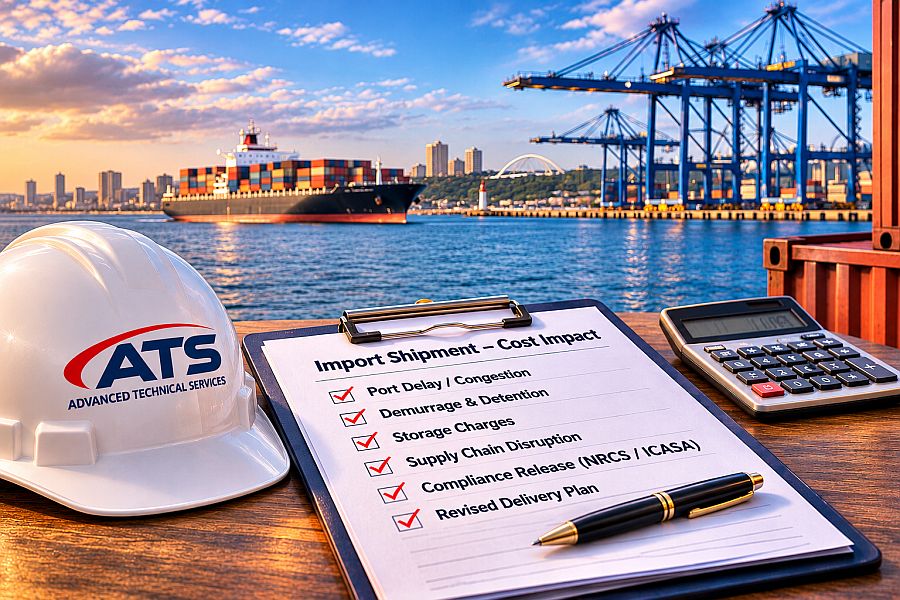
Importers generally understand the obvious components of landed cost. There is the purchase price, international freight, insurance, applicable customs duties, import VAT, clearing charges and local transport. What is less predictable is the financial exposure created when the normal movement of cargo is interrupted. Consider the different costs that may arise.
Demurrage generally concerns charges associated with a container remaining at the terminal beyond the shipping line’s permitted free period.
Detention generally concerns charges when the shipping line’s container is retained outside the terminal beyond the allowed period.
Storage refers to charges for occupying space at a terminal or storage facility.
These are different charges, governed by the applicable shipping line, terminal and commercial arrangements. They should not be treated as interchangeable. Importantly, a vessel waiting offshore does not necessarily mean that all three charges are already accumulating. The relevant free-time periods, contractual terms and charge triggers must be checked. Nevertheless, once containers become subject to these charges, costs can escalate rapidly. And even when no demurrage or detention is payable, the importer may still suffer substantial financial losses.
Twenty Days Can Change Everything
Imagine an importer expecting a shipment of electrical equipment to become available during the first week of November. The business has planned its stock purchases around that arrival date. Customers have placed orders. Sales staff have promised delivery. Technicians may have been scheduled to install equipment.
Now add another two or three weeks to the supply chain. The consequences extend beyond the inconvenience of rescheduling deliveries. The importer may need to finance inventory for longer than anticipated. Customers may cancel orders or purchase from competitors. Installations may need to be postponed. A manufacturer relying on imported components may have to interrupt production.
Seasonal merchandise may arrive after the period in which it was expected to sell. And a business operating with limited working capital may find that the delay affects its ability to pay suppliers or fund subsequent shipments. In some circumstances, the importer may decide to bring replacement goods in by air. That can preserve production or satisfy an important customer, but it may be extraordinarily expensive compared with sea freight. Metair’s reported experience illustrates that this is not merely a theoretical concern. When imported components are essential to maintaining a production line, the cost of an interruption can exceed the additional transport expense by a considerable margin.
The true cost of port congestion is not measured only in container charges. It is measured in everything that cannot happen while the goods remain unavailable.
A Delayed Container Can Still Have a Compliance Problem
This is where the situation becomes particularly relevant to technical compliance. Port congestion and regulatory detention are separate issues. A vessel may be delayed because terminal equipment, container handling or vessel scheduling is not functioning efficiently.
A shipment may subsequently be detained because a regulatory authority requires documentation, inspection, approval or other evidence of compliance. The fact that a container has already spent weeks waiting to be discharged does not exempt its contents from South African import requirements. Consider an importer whose electrical equipment requires an NRCS Letter of Authority.
The container may have experienced a substantial port delay before the importer discovers that the LOA is missing, expired or does not cover the actual model. Alternatively, a consignment containing radio equipment may encounter an ICASA approval problem. A shipment may also be selected for inspection or require clarification of its declared product classification.
These are different circumstances, involving different procedures. But from the importer’s perspective, they have something important in common. The goods still cannot be released for their intended purpose. And the time already lost at the port cannot be recovered.
The Dangerous Assumption About Embargo Releases
Importers sometimes assume that if a product encounters a compliance problem, the goods can simply be released under embargo and the necessary documentation obtained afterwards. That is not a safe assumption.
An embargo release, where permitted by the relevant authority, is a controlled regulatory arrangement. It is not an automatic entitlement and does not necessarily authorise the importer to sell, install or use the goods. The applicable conditions may require the consignment to remain at a specified location, under quarantine or subject to other restrictions until the regulator is satisfied.
In some cases, an embargo release may not be granted at all. Importers therefore need to distinguish between the physical movement of a container and the legal release of its contents for sale or use. A container can be removed from a port while its contents remain subject to regulatory restrictions. That may reduce certain logistics pressures, but it does not resolve the underlying compliance problem. And depending on the circumstances, warehousing, handling, transport and other costs may continue.
Who Pays When the Port Causes the Delay?
This is one of the more difficult commercial questions. Importers understandably feel that they should not be responsible for additional charges arising from circumstances entirely outside their control. Unfortunately, responsibility for delays and liability for associated charges are not always the same thing.
The answer depends on the contracts involved, the applicable shipping line and terminal tariffs, the cause and timing of the delay, and any relevant relief arrangements. The importer should establish which party is contractually responsible for each charge and whether any waiver, extension or dispute procedure is available.
Shipping lines and terminal operators may introduce temporary arrangements during periods of exceptional congestion, but these should not be assumed to apply automatically. Similarly, the choice of Incoterms can affect the allocation of costs and responsibilities between buyer and seller, although it does not eliminate the need to examine the actual transport and service contracts.
Where substantial charges are disputed, the importer may need assistance from its clearing agent, freight forwarder, shipping line or legal adviser. The important point is that a delay caused by port congestion does not automatically mean that every associated charge will be waived. That is a commercial risk importers need to understand before the shipment arrives.
The Hidden Risk of Changing Ports
When Durban experiences serious congestion, diverting cargo to another South African port may appear attractive. Depending on the shipping service and destination, ports such as Ngqura, Gqeberha or Cape Town may offer alternatives. But changing the port of discharge is not necessarily a simple solution.
The shipping line must be able and willing to accommodate the change. The alternative port must have suitable capacity and handling facilities. Additional inland transport may be required. A shipment originally intended for Gauteng may incur significant road or rail transport costs if discharged at a more distant port.
There may also be implications for customs documentation, transport arrangements, cargo insurance and the availability of suitable inspection or storage facilities. For regulated goods, the importer should ensure that the revised logistics arrangements remain consistent with any applicable inspection, detention or embargo conditions. A different port may reduce one problem while introducing another. The decision should therefore be based on the total cost and practical feasibility of the alternative route, not simply the apparent length of the queue at Durban.
What Importers Can Actually Do
Importers cannot repair cranes, reorganise terminal operations or eliminate vessel backlogs. But they can take practical steps to reduce the commercial consequences.
First, build realistic contingency time into import planning. Historical transit times are not necessarily reliable indicators during a period of severe congestion. Businesses should obtain current information from their freight forwarders and avoid making delivery commitments based solely on the shipping line’s original estimated arrival date.
Second, understand the applicable free-time arrangements. The importer should know when storage, demurrage and detention charges may begin, what extensions or relief arrangements are available, and who is responsible for monitoring the relevant deadlines.
Third, prepare customs and regulatory documentation before arrival. Where a product requires an NRCS LOA, ICASA type approval or other regulatory documentation, the importer should establish the requirements before shipment. That includes confirming that the approvals cover the actual products and models being imported.
Fourth, maintain clear communication with the clearing agent and freight forwarder. A container’s location, customs status, terminal availability and regulatory release status are not necessarily the same thing. Accurate information is essential to deciding what action is possible.
Fifth, consider the financial consequences of extended delays. For businesses dependent on imported components or seasonal stock, contingency planning may include alternative suppliers, revised inventory levels or carefully evaluated alternative transport arrangements.
None of these measures guarantees that a shipment will arrive on time. But they can reduce the likelihood that an already difficult logistics situation becomes a much more expensive commercial problem.
Compliance Preparation Can’t Fix the Port — But It Can Prevent a Second Delay
There is a limit to what technical compliance consultancy can achieve in a port crisis. A compliance consultant cannot make a vessel berth sooner. We cannot accelerate crane movements, eliminate terminal congestion or guarantee that Customs will release a particular shipment.
What we can do is help importers identify and address technical regulatory requirements before their goods reach South Africa. That may involve establishing whether a product falls within an NRCS compulsory specification, evaluating the manufacturer’s test reports, identifying the need for ICASA approval or resolving discrepancies between the product and its supporting documentation.
It may also involve determining that a particular approval is not required. The purpose is not to create more paperwork. It is to avoid discovering an unnecessary regulatory obstacle after the importer has already committed to purchasing and shipping the goods. When port delays are already adding weeks to supply chains, an avoidable compliance problem is the last thing an importer needs.
The Bigger Cost to South Africa
The effects of persistent port congestion extend well beyond individual importers. Manufacturers depend on imported raw materials and components. Retailers depend on reliable inventory replenishment. Exporters depend on predictable access to international shipping services. Freight forwarders, transport operators, warehouses and other logistics businesses depend on cargo moving through the system efficiently.
When that movement becomes unreliable, the consequences spread through the economy. Businesses may increase inventory to compensate for uncertainty, tying up working capital. Manufacturers may incur additional costs to avoid production interruptions. Importers may pass some of those costs on to customers. International suppliers and buyers may begin to regard South African logistics as less predictable.
And the longer these conditions persist, the more difficult it becomes for businesses to plan confidently. The debate over the future management of Durban’s container terminals is therefore important. But whatever the eventual operational solution, the immediate commercial reality remains the same. South African businesses need ports that function reliably.
When the Port Stops, the Costs Don’t
The importer waiting for a container at Durban may have done everything correctly. The goods may be properly manufactured. The supplier may have been paid. The shipping documentation may be complete. The required regulatory approvals may already be in place.
And the shipment may still be delayed for reasons entirely beyond the importer’s control. That is the uncomfortable reality of international trade. Not every risk can be eliminated, and not every delay can be prevented. But importers can distinguish between risks they must manage and problems they can avoid.
Port congestion belongs largely in the first category. Missing approvals, unsuitable test documentation and preventable compliance errors should not. At Advanced Technical Services, we cannot promise that your container will arrive on schedule. We can help establish whether the products inside it meet the applicable technical regulatory requirements before they are shipped.
Because when a container has already spent three weeks waiting at a port, discovering that its compliance documentation is inadequate is a particularly expensive way to learn what should have been checked before departure.