
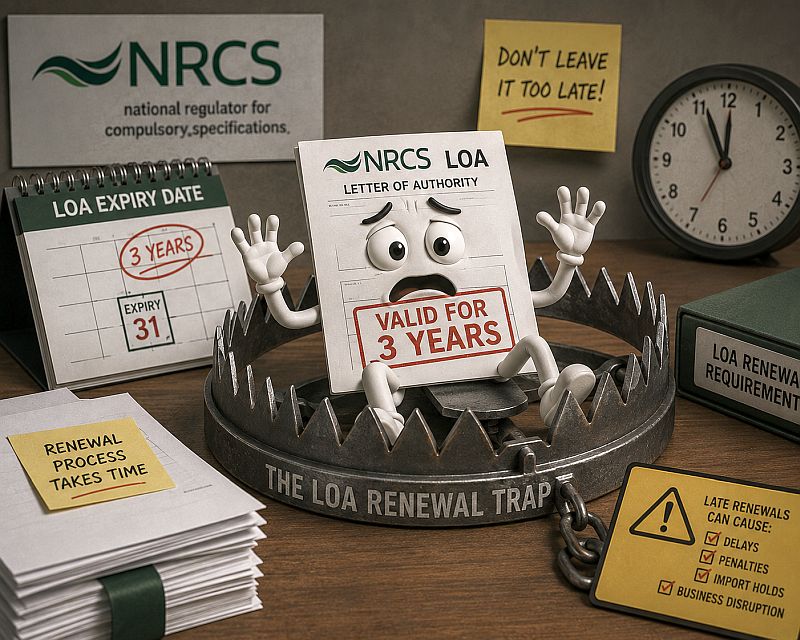
An NRCS Letter of Authority is not a permanent licence. It is issued for a fixed period of three years. Once that period ends, the LOA expires and the product is no longer authorised for sale or distribution in South Africa.
Many importers only discover this reality when a shipment is already on the water or sitting at the port. By then it is often too late to avoid costly delays.
The Common Misunderstanding
A large number of clients assume two things:
- That the LOA remains valid indefinitely as long as the product does not change.
- That they can simply lodge a renewal application a week or two before the expiry date and continue trading without interruption.
Neither assumption is correct. The LOA has a hard expiry date. Once it lapses, the product is treated as unapproved until a new or renewed LOA is issued. Customs and the NRCS do not grant automatic extensions while a renewal is being processed.
What Happens When the LOA Expires
- Goods that arrive after the expiry date can be detained at the port.
- Existing stock already in the country becomes illegal to sell.
- Retailers and online platforms may be instructed to remove the products from sale.
- Demurrage, storage and container detention charges start accumulating while the renewal is finalised.
- In some cases, the NRCS may require updated test reports before issuing the renewed LOA, adding further weeks or months to the process.
Why Last-Minute Renewals Frequently Fail
Renewal is not a rubber-stamp exercise. The NRCS examines whether:
- The original test report is still within the allowed age limit (generally five years for renewals).
- The product design and critical components remain the same.
- The current edition of the applicable SANS/IEC standard is still covered by the existing report.
- All model numbers listed on the original LOA are still accurate.
If any of these elements have changed, or if the test report is now considered outdated, the NRCS will request additional information or new testing. Starting this process only days before expiry almost guarantees a gap in authorisation.
The Practical Reality of Timing
A clean renewal can still take several weeks. A renewal that requires supplementary testing or clarification can take several months.
The safe approach is to begin the renewal process at least six to nine months before the LOA expires. This provides enough time to address any issues the NRCS raises without interrupting your supply chain.
Recommended Steps
- Diarise the exact expiry date of every LOA you hold.
- Review the supporting test reports 9–12 months before expiry.
- Confirm whether any design, component or manufacturing changes have occurred.
- Check that the test report still aligns with the current compulsory specification.
- Lodge the renewal application well before the expiry date.
- Do not ship new stock against an LOA that is about to expire.
The Bottom Line
An expired LOA stops your goods at the port just as effectively as never having had one. Waiting until the last moment turns a routine administrative task into a commercial crisis involving detained containers, mounting demurrage, and lost sales.
The three-year validity period is not a suggestion — it is a hard limit. Treat the expiry date as a critical business deadline, not an afterthought.
If any of your LOAs are approaching the three-year mark, or if you are unsure about the status of your current approvals, contact us for a review. It is far cheaper to start the renewal early than to resolve a blocked shipment later.
Stay compliant. Avoid delays. Protect your business.