
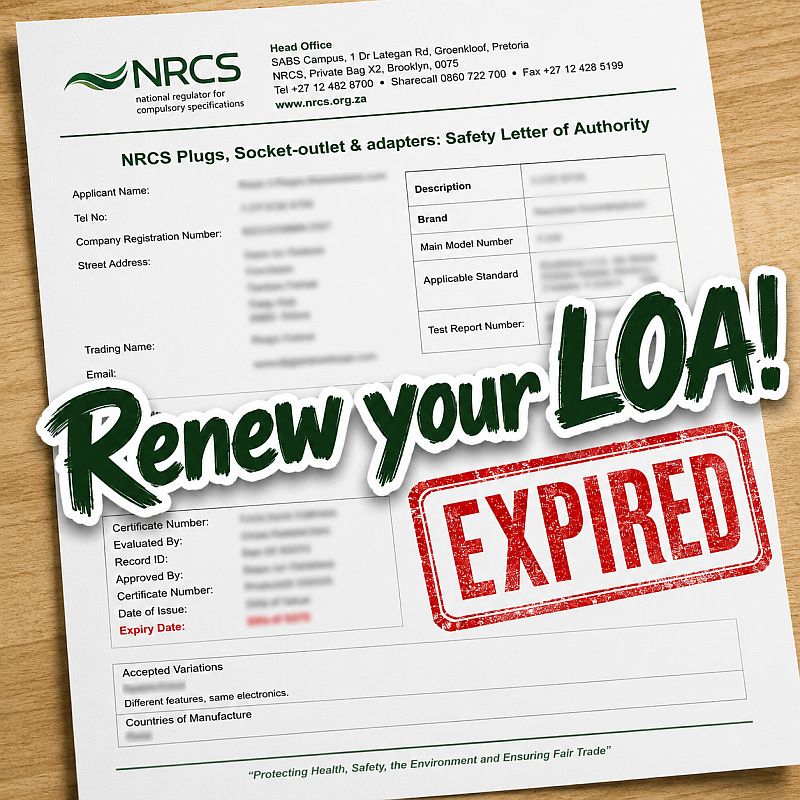
Obtaining a Letter of Authority (LOA) from the NRCS is only the first step. Keeping it valid is often where importers and manufacturers run into trouble. Many assume that renewal is a simple administrative exercise — submit the old documents, pay the fee, and continue trading. In practice, renewals frequently stall or get rejected for reasons that could have been avoided with better preparation.
Here are the most common challenges we encounter when helping clients renew their electrotechnical LOAs.
1. Test Reports That Have Expired or Are About to Expire
For a new LOA application the test report must generally be no older than three years. For a renewal the NRCS allows reports up to five years old, provided the product design has not changed.
The problem arises when the original report is already four or five years old and the product has undergone even minor modifications, or when the laboratory accreditation status or standard edition has changed in the interim. In these cases the NRCS often requests a new or supplementary report. Clients who wait until the last minute discover that retesting can take weeks or months.
2. Product Design or Component Changes
Any change to the product — different power supply, revised PCB, new enclosure material, alternative plug, or even a different manufacturer of a critical component — can invalidate the existing test report. The NRCS expects the report to remain representative of the product currently being imported or manufactured.
Many suppliers change components without informing the importer. By the time the renewal is due, the original report no longer matches the product on the shelf.
3. Updates to the Compulsory Specification or SANS Standard
Compulsory specifications and the underlying SANS/IEC standards are periodically revised. When a standard is updated, older test reports may no longer demonstrate full compliance, even if the product itself has not changed.
This is particularly common with standards such as SANS 60335-1 (household appliances), SANS 62368-1 (IT and AV equipment), and the SANS 60598 series (luminaires). A report written to an earlier edition can be rejected during renewal if the current compulsory specification references the newer version.
4. Missing or Inadequate Conformity of Production Evidence
For renewals the NRCS may request evidence that the product is still being manufactured to the same design and quality as the original tested sample. This is often called Conformity of Production (CoP) or a declaration of continued compliance.
Simply submitting the old test report is frequently not enough. Without supporting documentation (factory declarations, quality records, or a fresh sample evaluation), the application can be delayed or refused.
5. Changes in Manufacturer or Factory
If the LOA was issued against a specific manufacturer or factory address and production has moved (or a new supplier has been appointed), the original LOA may no longer be valid. The NRCS links the approval to the manufacturing source. A change of source usually requires a new application or at least a formal amendment supported by fresh documentation.
6. Incomplete or Outdated Supporting Documents
Even when the test report is still acceptable, renewals can fail because of missing photographs, incorrect model numbers, outdated company registration details, or incomplete application forms. Small administrative gaps cause the same delays as technical problems.
Practical Steps to Reduce Renewal Risk
- Diarise LOA expiry dates well in advance (ideally 9–12 months before expiry).
- Keep a clear record of any design or component changes since the original approval.
- Confirm that the current SANS/IEC standard referenced in the compulsory specification still matches your existing test report.
- Ask your supplier whether the manufacturing site or critical components have changed.
- Have the existing report and supporting documents reviewed before you submit the renewal.
The Bottom Line
An LOA is not a “set and forget” document. Renewal challenges almost always stem from outdated test evidence, unreported product changes, or standard updates that the importer was not tracking. Addressing these issues early is far cheaper and less stressful than dealing with a rejected application or, worse, being unable to sell stock while a new report is obtained.
If your LOA is approaching expiry, or if you are unsure whether your current documentation is still acceptable, contact us for a review. We assess renewal readiness every week and can tell you quickly what (if anything) still needs attention.
Stay compliant. Avoid delays. Protect your business.