A little preparation before requesting an NRCS LOA or ICASA approval quotation can save importers time, money and a great deal of unnecessary correspondence.
One of the most common questions we receive at Advanced Technical Services (ATS) is straightforward: “How much will it cost to obtain an NRCS Letter of Authority for my product?” Unfortunately, the answer is not always straightforward.
Before we can provide a meaningful quotation, we need to establish exactly what the product is, who manufactures it, which models are involved and what testing has already been completed. That sounds simple enough, but obtaining this information can sometimes involve weeks of correspondence between the importer, supplier, manufacturer and testing laboratory.
In many cases, submitting the actual application is the relatively straightforward part. Getting the documentation into a condition where an application can be submitted is where much of the work takes place.
The good news is that importers can often reduce this preliminary work considerably, and potentially save themselves money, simply by asking the right questions before contacting us.
The quotation that isn’t quite a quotation yet
Imagine contacting a building contractor and asking how much it will cost to build a house, without providing any plans, dimensions or specifications. The contractor could give you a rough estimate, but it would be little more than a guess.
Product compliance works much the same way.
We regularly receive enquiries asking for the cost of obtaining approval for an electrical appliance, industrial machine, battery charger, inverter or wireless device. Sometimes the enquiry includes a photograph. Occasionally there is a product brochure. Quite often, there is little else. We cannot responsibly determine the applicable approval requirements, testing needs or likely costs without knowing what we’re dealing with.
An NRCS Letter of Authority is not simply a certificate that can be purchased for a product. It is a regulatory approval supported by technical evidence demonstrating compliance with the applicable compulsory specification. Similarly, ICASA Type Approval involves identifying the relevant radio or telecommunications functions and establishing whether the available technical documentation meets South African requirements.
Before we can quote accurately, we first need to establish the scope of the work.
Ask your supplier before asking us
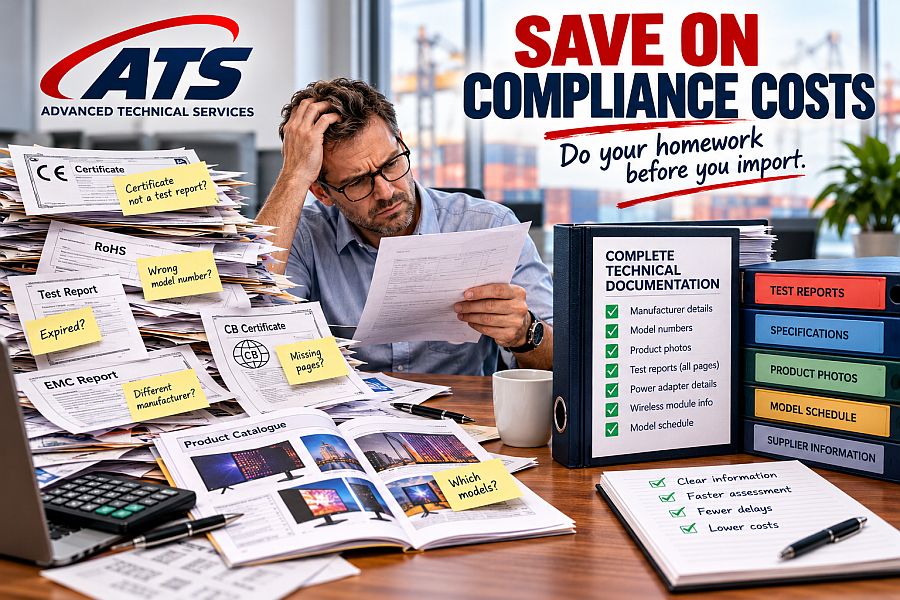
Your supplier should be your first source of technical information. Before approaching ATS, ask the supplier for the manufacturer’s full name, the exact product model numbers, technical specifications, photographs of the product and its identification label, and copies of any existing test reports and certificates.
If you intend importing several models, obtain a complete model schedule rather than sending us one model at a time. For equipment supplied with external power adapters, we also need to know the adapter manufacturer, model number and electrical ratings. An apparently straightforward product may involve more than one regulatory consideration.
For equipment incorporating Wi-Fi, Bluetooth, cellular connectivity or other radio functions, the manufacturer should be able to identify the wireless modules used and provide the relevant radio test documentation. You do not need to know which standards apply or whether the documents will be accepted in South Africa. That is part of our assessment.
What matters is obtaining the information that already exists.
A certificate is not necessarily a test report
This is probably one of the most common misunderstandings we encounter.
A supplier is asked for a test report and responds with a CE certificate, a declaration of conformity or a single-page document bearing an impressive collection of logos. Sometimes the document is entirely legitimate. It simply isn’t the document we requested.
A certificate may identify a product and reference particular standards, but it does not necessarily contain the detailed technical evidence required to support an NRCS application. The underlying test report typically contains information about the equipment tested, the test methods applied, the results obtained and the laboratory responsible for the work.
These details matter. Without them, it may be impossible to establish whether the product meets the applicable South African requirements.
The solution is simple: when requesting compliance documentation from your supplier, specifically ask for the complete test reports, including all pages and annexures, rather than certificates alone. If the supplier has a CB certificate, ask for the corresponding CB Test Report as well.
This one step can eliminate a surprising amount of unnecessary correspondence.
The model number matters more than you might think
Another recurring problem involves discrepancies between the product being imported and the equipment identified in the test documentation. The supplier may advertise a product under one model number, manufacture it under another and provide a test report identifying a third.
Sometimes the differences are perfectly legitimate. A manufacturer may produce the same equipment for several brands, or use different model designations for different markets. However, these relationships must be supported by appropriate documentation. We cannot simply assume that products are technically identical because they look alike.
The same principle applies when importing a range of similar products. A manufacturer may offer ten sizes or capacities of what appears to be the same equipment. Depending on the applicable requirements, design differences and supporting test evidence, it may be possible to include multiple models in one approval application. But this is not automatic.
Providing a complete model schedule at the beginning allows us to investigate the possibility of grouping models before unnecessary applications or testing are commissioned. That can make a meaningful difference to the overall cost of compliance.
Check the date before sending the document
Test reports do not necessarily remain suitable for regulatory applications indefinitely. For relevant NRCS electrotechnical applications, report-age requirements can be particularly important. A report that was perfectly acceptable when issued may no longer satisfy the requirements for a new application. There are also questions of laboratory accreditation, the standards and editions used, and whether the tested equipment still corresponds to the product currently being manufactured.
We do not expect importers to investigate accreditation scopes or interpret complicated test-report histories. However, you can save time by checking the issue date before forwarding a report and asking your supplier whether newer reports are available.
If the supplier provides a report from several years ago, tell us. If the product has been modified since testing, tell us that too. A little transparency at the beginning is far more useful than discovering these issues after an application has been prepared.
Why incomplete documentation can increase your costs
There is a common misconception that the cost of obtaining an LOA consists mainly of the application fee charged by the regulator. In reality, the total cost can include technical assessments, document verification, laboratory testing, correspondence with manufacturers, preparation of model schedules, application administration and responses to regulatory findings.
Some of this work is unavoidable. Other work arises because essential information was missing, incorrect or inconsistent when the enquiry began.
Consider a supplier who repeatedly sends incomplete documents. Each new submission may need to be reviewed, compared with earlier information and checked against the product being imported. If a test report is unsuitable, we may need to investigate alternative documentation or obtain quotations from accredited laboratories for additional testing. That work takes time, even when no application has yet been submitted.
By gathering the available documentation before requesting a quotation, importers allow us to assess the project more efficiently and identify potential problems earlier.
The objective is not to eliminate professional compliance work. It is to eliminate as much unnecessary work as possible.
What you should not have to do yourself
There is an important distinction between preparing properly and attempting to become your own compliance consultant. We do not expect clients to interpret compulsory specifications, determine the correct IEC standards, evaluate laboratory accreditation or establish whether a particular model qualifies for inclusion in an existing test-report family.
Those are technical and regulatory questions requiring specialist assessment. Nor should importers assume that a supplier’s statement that a product is “CE approved”, “IEC certified” or “suitable for South Africa” automatically establishes compliance with South African legislation.
Our role is to evaluate the available evidence, identify the applicable requirements, advise on any deficiencies and manage the appropriate approval process. Your role is to provide accurate information and help us obtain the technical documentation from the people who designed, manufactured and tested the equipment.
When both sides do their part, the process becomes considerably more efficient.
A useful question to ask before placing an order
There is one question we encourage every importer to ask a prospective supplier:
“Can you provide the complete technical test reports for the exact models I intend purchasing?”
Not just a certificate. Not just a photograph of a label. And not simply an assurance that the product has been exported to other countries.
Ask for the reports. If the supplier cannot provide them, that does not automatically mean the product is unsafe or unsuitable for importation. It does mean that further investigation, documentation or testing may be required. And that could affect both the cost and the time needed to obtain South African approval. Ideally, these questions should be answered before you pay a deposit, place an order or arrange shipment.
Discovering that additional testing is necessary while your goods are still at the factory is inconvenient. Discovering it when a container has already arrived in South Africa can be considerably more expensive.
Help us spend less time chasing documents
At Advanced Technical Services, we work with importers, manufacturers and suppliers to navigate South Africa’s NRCS and ICASA regulatory requirements. We understand that international product compliance can be complicated, particularly when suppliers are unfamiliar with South African requirements. We also understand that most importers simply want to know what is required, what it will cost and how long it will take.
The more complete the information we receive at the beginning, the sooner we can provide meaningful answers. We don’t expect you to become a compliance specialist. That’s why we’re here.
But a little preparation on your part allows us to spend less time chasing documents (thus charging you more) and more time getting your products approved.
Planning to import electrical or wireless equipment?
Before placing your order, gather your supplier’s technical documentation and let ATS assess the applicable South African compliance requirements. We can help identify potential approval issues, assess existing test documentation and advise on the most appropriate way forward.
Advanced Technical Services — helping importers understand compliance before it becomes an expensive problem.